Most-Read

Tuesday, October 24, 2017

Where is Decolonization in Environmental Justice?: Jaskiran Dhillon's Critique

I learned about the work of brilliant activist-scholar, Jaskiran Dhillon, at the Human Rights symposium in St. Louis October 11-12, 2017, the subject of my last blog post.  Dhillon is an assistant professor of Global Studies and Anthropology at the New School, and is from a tiny town in Treaty Six Cree Territory, Saskatchewan.   Raised by politicized parents, she quickly became involved in decolonial activism, and does this work across the globe, particularly in Canada and Burma and, recently, in solidarity with Standing Rock.  Author of Prairie Rising: Indigenous Youth, Decolonization, and the Politics of Intervention, Dhillon gave a plenary talk at the Human Rights symposium that developed an anti-colonial critique of environmental justice. 

A couple of random highlights:

·      Voicing a position I have a hard time conveying to my environmentalist students, Dhillon is suspicious of the new craze to integrate Traditional Ecological Knowledge (TEK) into Climate Change science and policy.  She reminded me that TEK is not a knowledge “resource,” as the language in the documents of federal agencies describes it, but rather an action word—it’s something that people do, not know.  The language of TEK as “resource” sets up TEK to be yet another thing to colonize for the purposes of settler-culture’s desire to adapt and survive climate change.  The “discovery” of the value of TEK on the heels of centuries of assimilation and oppression attests to the fact that settler culture only cares about indigenous ways when it suits their own agendas.  The potential for abuses of TEK and the communities that embody it—in the name of dominant white cultures battling or surviving climate change, while indigenous communities continue to bear the brunt of extraction politics—are high.  Dhillon asks, “whose interests are served when TEK is extracted in service of climate recovery?”, and says the problem is that the appropriation of TEK to protect “all of us” is not linked to the broader goals of indigenous sovereignty or dismantling settler colonialism.

·      Environmental justice (EJ) isn’t a useful term for indigenous movements, in part because it identifies the first race-based environmental abuses in the 1970s, with Love Canal and as documented by Robert Bullard’s Dumping in Dixie.  The origin story of EJ in the US ties it to the Civil Rights movement, whereas indigenous communities have been experiencing race-based environmental exploitation “since 1492.”  Also, for indigenous communities, colonization is above all an act of environmental violence. If we historicize the 1970s as the birth of EJ, we yet again erase indigenous history in the U.S. Alternatively, maybe EJ is just something else—not just a way to describe links between racial injustice and environmental degradation.  I think Dhillon might argue that settler colonialism’s own forms of environmental degradation ought to be described as its own thing. But it’s still really helpful for her to have pointed out the need for a more specific, precise definition of EJ so that colonialism isn’t ignored, yet again, and so that we can understand the nuances between different forms of racial injustice and their often quite different relationships to environmental degradation.  Another way of approaching it, she says, is to consider decolonization as a foundation to EJ.

·      Dhillon also made the brilliant point that climate change and settler colonialism are linked.  This may feel like a “no-duh” insight to those who study or live TEK, but this insight is really important as a follow-up to the above point: dominant environmental discourse often posits that industrialization (e.g. Leo Marx, Al Gore) or capitalism (e.g. Naomi Klein) are the root causes of climate change.  An anti-colonial critique of this narrative points out that colonialism paved the way for these later developments, and that ongoing colonial relationships enable these other phenomena to thrive.  Overthrowing capitalism or getting post-fossil-fuel won’t address the root problem.  Dhillon says that blaming capitalism is “a red herring.”  As such, a person can be fighting for fixing climate change and also be very much against indigenous sovereignty.  To take it further, I would add that this is precisely the kind of internal contradiction within the mainstream environmental movement that often assumes its “saving” of the planet will lead to social justice. 

·      Dhillon also writes about, but did not develop so much in the talk due to time limits, the links between NODAPL and police state violence, indigenous education policies, “man camps”, sex trafficking, and myriad other forms of cultural, physical, and sexual violence.   As she says, “NODAPL isn’t about a pipeline; it’s a fight for the co-existence of life.”

In the Q&A, Dhillon received a final question from an older white woman, who asked, voice quivering and nearly on the edge of tears: “I love my house.” Long pause.  “What are we supposed to do?”

I just about combusted in my seat, and wondered how Jaskiran would handle this.  She was a master class in difficult dialogue.  I wish I could relay precisely what she said, but basically, she firmly but calmly said, “that’s not my problem.  Find resources about how to work through your white guilt, find friends going through the same thing, and figure it out.  Start to see all the privileges you inherited so that you could have your house; this work is hard.”  She was firm about not coddling the white woman’s newfound epiphany of her complicity in colonialism, but did not punish her for asking the question.  I asked Jaskiran what she thought of that exchange, and I was really impressed that she welcomed the question and commended the woman for saying what so many people think, but fear saying.  


I’m still mulling over all that happened at that conference, but certainly Dhillon’s talk and her Q&A taught me so much about the messiness of the relationships between the climate movement and decolonization, and between EJ and indigenous rights. 

Wednesday, October 18, 2017

Is There Room for Environmental Justice in the Human Rights Framework?: A Plenary at the Human Rights Symposium


Last week, I had the honor of being a plenary speaker at a superb symposium hosted annually by the Institute for Human Rights and Humanitarian Studies at Webster University in St. Louis.  The theme of the conference for this International Year of Human Rights was Environmental Justice.  The organization of the symposium was a 2-day series of speakers ranging from NAACP Environmental and Climate Justice staff and local nuclear waste dumping filmmaker-activists to academics working on environmental justice.  We had opportunities to each speak and answer questions, to meet with each other and members of the audience, and then speak together in a roundtable.

It was both an alarming and an uplifting experience, for the range of folks there from different points of access around issues of environmental justice, and for the engagement with the local issues of St. Louis.  I learned so much about St. Louis, in terms of its history of segregation, the related protests occurring there now due to the lack of justice for Anthony Lamar Smith, a black man killed by a police officer who was recently acquitted, and nuclear waste dumping (St. Louis is the city nobody talks about regarding America's nuclear era).

As an academic trained in scholarship, I am sad that I'm not around activists and agency people more often, who come to the questions I theorize and historicize from really pragmatic and situated perspectives.  I was in heaven having conversations around shared themes and sharing tools from our respective areas of expertise.  It was gratifying to feel I had something to offer them, too, since usually it feels like only the other way around.

Speaking of the value of scholarship and theory to that work, I have made it a goal this year to learn how to give more dynamic talks because I am starting to be invited to give them more, and in a wider array of settings.  If I ever cared to make my scholarship meaningful and have an impact on the world, this surely seems my chance, right?  I'm so used to dismissing publications and the precious work of intellectual life as irrelevant to what's happening "out there" in the "real world," or perhaps I've just internalized that critique from my students and from society at large, which is so anti-intellectual at this current moment.   Also, the neoliberalization of higher education isn't doing us any favors.

But speaking to the public is one way--definitely not the only way--we academics can scale out our work, while making academia seem more relevant to people "out there" or "in the real world," less highfalutin.  So, I'm slowly working to do more choreographed, extemporaneous speaking, focusing on only one guiding insight or gap in the dominant knowledge, and providing provocative examples, stories, or visuals.

I don't want to be beholden to the podium and its microphone or its Power Point advancing buttons.  I want to move around, not just be a big brainy head popping up over a big wooden lectern hiding my body.  I want to change the affect in the room to be more receptive to the thoughts that I must think are so fabulous I just had to occupy all the audience's space and time to share.

My talk was on the relative merits and pitfalls of bringing the tools of environmental justice into considerations of "human rights".  I particularly wanted to focus on the differences between environmental and social justice efforts, and why there is a lot of suspicion of environmental groups entering social justice conversations.  Here, I drew on my book, The Ecological Other, to explain the history of social oppression in the name of nature.  I concluded by drawing on Julie Sze and Lindsey Dillon's work on "Police Power and Particulate Matters" to use the case of Eric Garner's last words, "I Can't Breathe" to illustrate the value of a environmental justice analysis that recognizes a shared root of structural violence causing both police brutality and increased health hazards in black communities, to help connect the context of what's happening in St. Louis to the topic of the symposium.

Meanwhile, I learned an immense amount from the following plenaries who shared the lineup with me:

  • Jaskiran Dhillon, scholar-decolonial activist and author of Prairie Rising: Indigenous Youth, Decolonization, and the Politics of Intervention (2017). 
  • Carl Zimring, author of Clean and White: A History of Environmental Racism in the U.S.


  • Carolyn Finney, scholar-activist and author of Black Faces, White Spaces: Reimagining the Relationship of African Americans to the Outdoors

  • Marnese Jackson and Bruce Morrison, NAACP Environmental and Climate Justice representative and lawyer, respectively.
Marnese Jackson, me, and Bruce Morrison at the symposium
  • Carl, Allison, and Dawn, creators and subjects in The First Secret City, a brand-new documentary seeking to raise attention  around the health impacts of aluminum processing and the movement of nuclear waste around the city.
  • Sylvester Brown, Jr., who had an illustrious career as a reporter and writer, before launching his answer to the economic problems that give rise to violence against blacks-- The Sweet Potato Project. 

Carl considered Dove's retracted ad campaign from the weekend in his analysis of "racial hygiene" in America
____________________________
Thanks so much to Lindsey Kingston, Kate Pearsons, Karla Armbruster, for bringing me to Webster for this event, and to my beloved student Madi Whaley for helping me conceive of and build this talk, ground me in the St. Louis protests, and find some resources on how to deliver talks better.  Also, a highlight of the trip for me was exchanging ideas with this troop of young activists (below) who made all our work on stage pale in comparison to the work they do "out there", but also, they were so rad because they cared to make the "experts'" lectures relevant to their own efforts- Andrew, Adam, Amber, and the crew, pictured below.  Kids these days....


Wednesday, October 4, 2017

Research is My Dirty Little Secret

In a time of sweeping budget cuts and anti-intellectualism, one of the parts of my job that is first on the chopping block is this amorphous thing we academics call "research."

I don't know about you, but my institution is squeezing more and more out of everybody, the most precarious lecturers most of all. 

"Work creep" is everywhere--for example: we got rid of our college's website manager, and now our personnel manager will be doing all that website work.  The part of her personnel work that is getting displaced is the travel stuff.  Our departments have to figure out how to internalize that labor.  This is happening everywhere.  Meanwhile, administrative bloat is a thing: those flow charts of who reports to whom are mind-bogglingly complicated, and seem to change every year.  

For one unit of advising time, I'll be asked to advise not 45 students, but 70, for example, in the next budget cut.

I'll teach the same amount of classes, but head count will go up 25%.

Lecturers will lose classes.

Squeeze, squeeze, squeeze. 

In this context, committees are convened to strategize how to survive these budget cuts, creating "urgent" service work.  Much more work is spread among fewer people.  Though I'm glad to have a secure job that renders me one of those people who stays in work, I fear for the increased precarity of those who do not.  And I am sad about what it's doing to academia in a cultural moment when intellectual "elites" are losing status in the public sphere by the minute.

Because beside lecturers' job security, what gets cut? What is the unnecessary "fat" in our work lives?  

Research.  

If it's not directly serving students-- and in administrative mumbo-jumbo that means, is it using student unit hours (head-count) as part of instruction?  Are you making your teaching/research obligations so efficient that you can literally do one by doing the other?  Are you leveraging your research to translate directly to tangible, measurable, immediate forms of student success?  Does your research have immediate impact on the classroom?  If not, good luck finding the space in this squeezed budget landscape to indulge yourself in the luxury that is thinking, writing, thinking, writing.

Superfluous to the obligations of student retention and over other imperatives of higher education (oh, for example, producing meaningful knowledge), research can only get done on the side-- it's definitely become my dirty little secret.  

Some of my colleagues are champions of me taking time to pursue my love of research.  They "take the hit" for me by stepping up to committees and making their service work count "double" for their programs and mine.  They compensate for my bureaucratic negligence, all the while enabling the slow creep of bureaucratic entanglements (assess more, report more, figure out more software interfaces, represent your program here and there and there... you know the drill).  I owe those colleagues many, many margaritas.  

But others, less sympathetic about the squeeze that my attention to research might entail for their workload, may find it a sign that I have too much time on my hands-- I'm not serving students enough and not on enough committees-- if I am discovered in the act of carving out time and space to write and think.  You're producing research?  It's like some kind of infidelity to the care of family I am supposed to be doing.  

How would this culture change?  Do we really need a better budget to make people think research is valuable to what we're doing at a liberal arts, teaching institution?  I don't think so.  I think there's something much worse going on here that we need to reckon with: the value of intellectual work in this historical moment, the neoliberalization of higher education, and the linking of educational outcomes entirely to whether or not students get jobs when they graduate.  I would like to have my battles on those grounds-- cultivating really compelling cases for the value of intellectual work in the world-- and not in the hallways of my campus or in the land of nasty work emails.  


Monday, October 2, 2017

"I Like Big Butts and I Cannot Lie": Or, Why I Should Put My Children in a Bubble

The other day, my nearly 7-year old came home singing "I like big butts and I cannot lie!"

Oh. My. God.

What have I done.

Titillated by my horror, she started singing it louder, and more, and smiling giddily while doing so.

Then, my 3 1/2-year old, who had been watching all of what is commonly known as the classic "child/parent nonverbal horror-titillation feedback cycle," joined in.  Because obviously.

Oh. My. God.

I'm a terrible mother. How did this happen?  How did I end with two children delightfully powering out this line from Sir MixaLot's "Baby Got Back" in the bathtub?

In moments like this, you have two choices, as I see it.  One: laugh, embrace the passing on of a classic song of my own generation to my kin, and appreciate my kids' exposure to all the pleasures of popular culture.

Alternatively, and less likely, I can undo their learning.  Good luck.   Parental advisory noted, but how was I supposed to see "big butts" coming down the pike?  I mean, she's only 7 for goodness sake!  I wasn't prepared for this.

Ok, so, let's go with option 1: laugh and try to make lemonade with these lemons.

I think of myself as a mediator of the world--not the maker of the world-- for my kids. I love grabbing these teaching moments by the horn, and relinquishing the pretense that I can be a kind of saran wrap around my kids, a prophylactic to cultural effluvia.

"Baby's Got Back" isn't really effluvia, either.  Actually, it was a feminist anthem of my generation.  Who can argue with "my anaconda don't want none unless you got buns, hon!"?  And c'mon, this is funny: "you can do side-bends or sit-ups, but please don't lose that butt!"  The song was an irreverent thumb in the eye of the expectations of femininity in American culture, which is and certainly was (in  1992, the year I consider the peak of musical craziness in my life) raced as much as it's gendered. That is, embracing a big butt was both a rejection of patriarchal culture's expectations of thinness and a rejection of white culture's ideals of femininity.


Sure, the song has problems. Sure, it still sexualizes women and dissects them into body parts, and does so in ways that don't do any kind of woman any favors.  The video of the song repeated all the same misogynistic tropes that the genre was famous for, except it did so with women who have large rear ends instead of skinny ones.  Not all that radical, you could say.  In some ways, sure, the song didn't undo as much patriarchy as it perpetuated.

Ok, but flash forward to your 7-year old girl coming home singing it in 2017.

I carry on the campaign to teach kids that women are whole people and that they are not reduced to their looks, regardless of the girth or lack thereof of their backsides.  We are more than our backsides.   But this song isn't the first chance I've had to have that conversation, PA-LEASE, people.

From Hillary to Melania to Michelle, ample opportunities exist to explore how women's whole identities matter little compared to their looks in American culture.  Sir MixaLot isn't the only one preaching that message.

The real challenge is to not be horrified by my child's lost innocence, because I can't keep her in a bubble forever.  She's going to grow up in this white supremacist patriarchal culture, so I'm going to start from that premise.  Instead of pretending that we aren't all breathing in all that toxicity all the time, whether we choose to recognize it or not (aka "white privilege"), or, even more importantly, whether we have no choice in the matter in the first place, I am going to unpack "Baby's Got Back" with my kiddos.

My near-7-year old loves talking about racial and sexual history and politics; she is profoundly interested in understanding how people operate and interact, and how power has worked in history.  So, even though I haven't quite figured out my approach with this particular song, I will.  By bringing that song home, she's opening up a wonderful window into the context of her daily life, and thus an opportunity to talk about these difficult conversations. I'll leave the sex stuff out (for now), but the gender and race stuff is being handed over on a silver platter; I want to rise to the occasion and take this chance to talk to her: why was the song was so powerful, what kind of cultural work was it doing when it came out, why might people not like hearing her, much less her younger sister, sing it, etc?

It'll be fun and important, one day, to deconstruct the cultural shenanigans going on in this Friend's episode, "The One with Ross's Inappropriate Song".  Why would this song be "inappropriate" in this show?  Why is this storyline "funny", and to whom?  What assumptions about race, class, and gender does the joke rely on to work," and who might it hurt?


At the very least, in any way my young girls can receive drips and drops of the message that big is beautiful, to shore up some strength against the tidal waves of "big is not beautiful", I'll take it.  Sir MixaLot did that for me and who knows how many other young women, and, obviously, still is.  The song may reinforce some kinds of problems even as it rejects one form of oppression, but I'll take it.

I'm not putting my kids in a bubble. My parents didn't put me in a bubble, though I do sometimes wish I hadn't seen so many damn Disney movies. Seriously.  I'm still traumatized by the realization that life after marriage is not happily ever after, just sayin'.

But if I can't control what my kids absorb in their hours when they aren't under my roof, I can at least parent the shit out of this song.


Monday, September 18, 2017

Friends Don't Let Friends Unpause: Curing Your Email Addiction

Oh Boomerang.... I do love you! It's an app. Get it.

You fling those emails away from me, like a shield deflecting arrows, poisonous tranquilizing darts.

You take over my email interface with a big blue "unpause" button, daring me to unplug the dam. You are a dike holding back the flood threatening to inundate my life with non-urgent, vapid, moist emergencies.

I sit at my computer, trained by the incoming emails, to wait more. Wait for another fire to put out, another flame to quell. It's become a sick habit, a twisted pleasure.  I'm on it, I'm busy, I'm responsive.  What for?  And at the cost of what?

Now, when the dam unleashes its fury at 6am, 1pm, and 3pm, I see a small litany of unimportant requests. I deal with them in 5 minutes. I don't waste time waiting for them. I don't intrude upon my family, my fuel, my loves, waiting... waiting... waiting... for all the requests that might make me feel important.


Research shows how much energy it takes to shift attention between one's "deep work" and shallow work.  Research shows how damaging email is to the psyche, to our sense of being overwhelmed by external pressures.  I have succumbed to those pressures, and have seriously wondered how I could possibly survive in my job without my addiction to email.  I respond to emails when I get up at night to pee, I respond to emails in the middle of other meetings, and I respond to emails while my children are trying to get my attention. My stupid smart phone makes this impulse to responsiveness all the more seductive.

Small fires are so fast to put out. Just give me a second, I have to just write this one quick thing.

____________

Here's the genius of Boomerang, for someone like me.  I'm not required to exert any kind of will power.  Turning off my phone's email ability hasn't worked.  Scheduling email times hasn't worked. Telling others that I don't check email except at certain times most definitely doesn't work.  Self-restraint DOES NOT WORK.  The quick-hit of email responsiveness is too addictive. You know what I mean, right?  If I'm not doing anything else, at least I'm performing a virtual persona of productivity.

This is just not acceptable anymore, for reasons I won't go into now.

______________

Suffice to say, Boomerang is your solution if you suffer from something similar.   Every time I have that impulse to check email on my phone: too bad! Every time I want to stop grading papers so I can check email (it's so much more interesting, no?), too bad! Every time I want to avoid my children's requests to see if more urgent requests are transmitting online, too bad!  Every time I want to avoid taking out the trash, too bad! Every time I want to pretend I'm so important in front of somebody who intimidates me, too bad!

I just simply must do something else with myself than open up my fucking phone.  It's brilliant.

Boomerang is also so genius because of the language it uses on the button it highjacks your email interface with-- "Pause"/"Unpause."  When you're in a "Pause" timeframe, Boomerang takes over your email and lets you know!  You can override the pause, and unplug the dam.  If you make the fateful decision to click on "Unpause", then God save your soul.  A little time clock thing will start, and, like a bomb going off, you'll start to see your inbox fill up.  Boomerang makes it hard to open the floodgates, discouraging you to make that decision whimsically.  The psychology of this is perfect for me.  I can't easily unpause on my phone; I have to be on my computer to do so.  The dam is breachable, but it's not easy.  Your interface is always reminding you to "Pause" again.

Let's pause on this idea of pause.  I have read several books on the value of the sabbath, the pause built into our rituals.  I have read at length about how our current work ethos punishes pausers.  Extract labor, extract labor, extract labor-- to think of this in Karl Marx's terms.  The interstitial moments, when nothing is happening, where nothing is taking place, have no value in contemporary life.  My loved ones send me articles cut out about how we need a pause from technology. I find beautiful articles in Buddhism magazines about the detriments of technological distraction.  I "get" why my email addiction is a problem.  But I haven't been able to translate that knowledge into action because, frankly, I'm weak when it comes to discipline and will power. Don't even ask about how much wine I drink, or the egregiousness of excuses I can muster to justify getting an iced mocha on any given day.

For a weak soul like me, Boomerang is some kind of savior.  I'm sure I sound like a proselytizing fiend, and I'm not getting paid to write this.  I genuinely want to share my story with  you, dear reader, of an addiction solved and a soul saved from the torturous drip, drip, drip of the email inbox.

What a genius name!  Can't touch me!


Update: despite no mention in the downloading process (I'm also not very detailed in my reading of fine print. See above, reasons why I need more time afforded by getting off email: because I'm BUSY!), it turns out this app costs money at some point.

I'm currently exploring its beauty, and wondering whether I can manufacture the kind of will power required to do what Boomerang does for me.  I'm also wondering why Google hasn't already created this functionality.... Anyway, sorry if I misled anybody, and get ready for that beautiful blue "Unpause" button to just go away.

I think I'll pay, as my friend Janelle says, because it's like you're getting your money's worth in email vacation!


Thursday, September 14, 2017

Is Trump a Liberal Stunt to Make America More Progressive?

Yeah, it's kind of a joke. But haven't you wondered?  He's so anathema to liberals.  But he's also anathema to conservatives.  Everybody's jumping ship.  The swamp is getting drained.  The art of the deal, or craziness?

Might there be some long-term good for progressives amid the horror?

For the record: I was one of those people who watched the 2016 election unfold into a lonely night of sleepless dystopia.  I have acquired a new series of anxiety conditions related to Trump: hives, anxiety, depression, etc. You know the drill.  I am a die-hard progressive and am disgusted and horrified and mostly heartbroken by the fraction of America that elected this beast.

But I'm starting to get it.  Even though I don't like it. Or agree with it.  I'm starting to get it.  We all need to start GETTING IT, even if we don't like it.

And, of course, as an academic, I am trying to pull myself outside of the vicissitudes of popular political media to ask "how is culture changing right under our noses? What's going on that people aren't talking about?"

Although I fundamentally disagree with the whole "empathy" bandwagon that liberals have espoused since Trump won, I do now for the first time understand (even though I disagree with) the logic of the so-called Trump base.  My politics always end up on the other side of them, but I'm starting to appreciate the "art of the deal," the irreverence to partisan status quo modus operandi, and the flashy political theatrics that constantly contradict his actions.

I was one of those privileged white people who didn't really recognize the shitstorm that was the race situation in American before Trump (B.T.).  I always understood that our wars, our prosperity, our definition of America had to do with the oppression of all kinds of people, and that this continues today.  But what is new A.T (After Trump) for this one liberal academic is a sense that I have to take these other viewpoints seriously, even if I don't agree with them.  I am now reading Strangers in Their Own Lands, along with Between the World and Me--not because I believe these two perspectives are relativistically all equally "right," (like "violence on all sides"), but because I do think that if we're going to move toward a more liberal society, we're going to need to engage these Trump supporters at their own terms.

In other words, what would it take to get into the same rooms and conversations with these isolationist, afraid folks who now have been brought even more out into the light?  It doesn't help us to get on our high horses, no matter how right they are.  So, what does it require from us to listen responsibly? Calling out is all fine and well, but to what end? What are we trying to achieve?

I don't know about you, but I want to change minds, hearts, and souls.  I think we have to figure out where our shared humanity is, instead of preach argumentation on a soapbox about our awesome liberal values.

You got my attention.  You're not just evil.  You are afraid.

Empathy is not the right word for this insight, and I am profoundly annoyed that popular discussion is so fixated on it.  Look it up, people, that's not what a national identity or a democratic state is based on.  Democracy is all about figuring out how to compromise amid differences.  I can scream my views more loudly, but all it will get me is laryngitis.

The zero-sum-game logic of Trump's base has been around for a long time.  He's not the problem.  He's just the symptom, it goes without saying. Let's stop beating this dead horse.  Let's stop talking about how crazy Trump is.  Obviously, he is.  But media that focuses on his craziness is missing his actual strategy, his actual actions.  Media coverage of Trump needs to change entirely, instead of applying the same metrics for this guy as they have for presidents past.  I'm not saying media should be inured to his craziness, but that they need to get much smarter about how they represent his craziness.  Just shaking heads over his crazy ain't getting us anywhere. I'm getting tired of it.

Trump's craziness is not interesting to me, beyond the usual shock factor that has always boosted his ratings.  I want to suggest that his swings and oscillations are totally consistent with each other, not signs of his eradic temperament. He is not, as liberals would like to think, and as pundits always tout in op-eds and late night shows, totally hypocritical.  Or at least, that's not just it. To dismiss his craziness as such is a grave mistake.

We are now living in a world where his hypocrisies make sense; we need to catch up.

For example: tweeting blustery stuff against immigration immediately after hanging out with "Chuck and Nancy" doing some bipartisan deals with democrats is an example of his potential to actually change the political ground we all stand on-- in potentially very liberal ways.   He doesn't care about allegiances; he cares most about his narcissism.  This may actually work in our favor.

Not to mention the way he's brought some conversations to the fore, and shaken up even the conservatives.  They have had to jump partisan ship to distance themselves from him.  Take Lindsay Graham, Lisa Murkowski, or John McCain, just as examples.  What will Trump do to the GOP?  I'm actually titillated to watch.

I wish pundits and news reporters would stop describing his inconsistencies as craziness-- it just fuels partisanship and the divisiveness in this country.  Trump shaking one hand while yanking the other's leg makes total sense; it is not hypocritical or two-faced.  It's precisely what he means by "the art of the deal" and "draining the swamp."  Hang out with Nancy one day, and Steve (Miller? Bannon?) the next.   Keep us wondering.   Is banishing Bannon part of his larger strategy?  Probably.

I am the biggest fan of the liberal news media, but the fact that they keep stomping moral high ground about Trump instead of seeing the genius of his strategy to play all sides is a sign that they may indeed need to improve.  There is new evidence out that media focused on "the negative" of Hillary's campaign more than his, and that the media handed him this election.  His assaults on the media are a brilliant way to distance himself from that debt, eh?

Obviously Trump is flipping the finger to the whole system, and regardless of his actual stances, this is why he has a base of people who love him.  I can't believe I'm going to say it, but I also sort of love him for it.  "Screw you. And you. And you."  He hates Paul Ryan as much as he hates CNN.  They're all missing the point.  Break the rules, throw everything into the air and see where it lands.

Trump isn't really a die-hard ideologue or Republican.  His ego may actually work in liberals' favor sometimes, and that he has no loyalty to Republicans.  He wants to piss them off too.  How might this all work out well for liberal progressive agendas?

There are some interesting possibilities, and I'm surprised more pundits aren't talking about them.  Yes, he's appalling and makes me want to throw up and cry all the time.  What is happening to the American dream? Going to hell, yes.

I do have an American Studies training, so this is actually important to me.  What "we" stand for as a nation-- and all our historical hypocrisies-- is important to me.  But I wonder if it's worth getting over my response to his demeanor (wanting to throw up), in order to stand back and watch a bit, and see how these pieces all fall down.

Republicans like Flake, McCain, and even Graham may turn more liberal than we've ever seen, and just to appease their own fans! What a radical thought!

Republicans may decide it's better to go with pro-choice, or pro-immigration, or pro-liberal-thing-of-your-choice in order to shore up the reactionary tide against Trump.  Politics might actually trump partisanship-- finally!  When it becomes acceptable for Republicans to support climate scientists and DACA supporters, you know Trump is reworking politics in fascinating ways that may actually benefit liberal agendas.

Middle of the road Republicans are going to look downright liberal compared to Trump, but so too will middle of the road politicians be held to a "higher" standard than they were before.  If Trump can be the consummate hypocritical narcissistic ever to walk the planet, but still see the benefit in screwing off all his party-liners in order to "make a deal," then perhaps we're not fully in the apocalypse yet.

Let's pay attention to the deals, not the swill coming out of this man's mouth, pores, and ass. It's hard, I know, because he is truly abhorrent on so many levels.  But culture is shifting under our noses and feet as we sit here agape at his boorishness.  The chits may fall in interesting places that liberal progressives might take great advantage of, if we're paying attention, and if we're not so horrified by what he does to women's pussies.  He may very well drain the swamp, and for the better, moving even right-winged folks more left in an effort to distance themselves from him.

Don't stop protesting. Don't stop calling your congresspeople, organizing your communities, mustering passion where you never thought it existed before. I'm not trying to downplay the urgency of the times.  But I do think, if you're a progressive, you must be squirming in your seat with glee just a little about the ways that he pisses off his base, other GOP folks, the usual suspects, almost as much as he pisses us off.

He may turn our stomachs and push all our buttons, but I wonder about the long term.  Maybe he's actually some kind of Frankenstein fantasized in the darkest hour of liberal nightmares.

Wednesday, September 13, 2017

Resilience: A Keyword in Environmental Studies?

Everybody likes the idea of resilience, right?

Resilience connotes bounce-back-ability.  Grit.  Adapting to change and dodging hardship.  Surviving struggle.

Why wouldn't we want to design resilience into communities, cities, architecture, cultures, young people?  Why wouldn't we want to raise our kids this way?  Why wouldn't we want to study the ways in which these things have proven resilient in the past, in order to emulate them for the upcoming storms?

Or, put another way, why would we resist grit, given all the shit?


We hear it like this:

What's wrong with millenials?  They lack resilience.

Why do we admire hardworking migrant farmworkers?  They're resilient.

What can we do about colonialism?  Cultural resilience.

Cities designed for climate change? Resilient.

Communities that can come out on top after a disaster?  Resilient.

Survivors of sexual violence, institutional racism, intergenerational trauma? Resilient.

Critiques of the word abound.  It's got a lot of problems, as these statements show.  Condescending, fetishizing, appropriating.....  It smacks of privilege.

It puts responsibility for pulling up bootstraps on the individual, and absolves structures and history of blame.

It erases, or risks appropriating, historical ways of managing colonial violence (e.g. Vizenor's concept of native "survivance").

In the context of climate change, "adaptation and resilience" become funding opportunities that accept business-as-usual carbon colonial-capitalism as inevitable and fixed.


Is it a good word? Can we talk about cultivating resilience in the Anthropocene without participating in all these erasures of blame and history?  Or is it just a worthy ideal we can all get on board with?

______________________

This keyword entry is inspired by a Facebook thread involving a cast of brilliant thinkers who expanded my own thinking immensely: Britta Spann, Julie Sze, Mary Mendoza, Jennifer Ladino, Deborah Miranda, Anita Mannur, Leena Dallasheh, Rachel Pye Hamling, Stacy Alaimo, Aubrey Streit Krug, and Dianna Fischetti.  I'd be so dumb and uninspired without these women.  Child development, social and clinical psychology, popular culture, indigenous studies, the environmental humanities-- these fields approach the term quite differently.  


Tuesday, September 12, 2017

"Are You Tired? You Look Tired!"; Or, "Why Aren't You Acting Like My Mom?"

If you read any of my posts, you know that I am thinking a lot about how to balance my love of teaching and the slippery slope that love falls into when I lose myself in their demands.  I'm sensitive to their feedback, worry about each of them, and do, in many ways, feel like their mom. And, as I noted in my last "rant" post, I do this willingly, and the payback is that teaching truly fuels me.

However, this past year's wealth of disasters--natural, political, and otherwise--has worn me (and many of you, and many of my students) very thin.  We're all keeping our heads just above (sometimes below) water, just treading, trying to anticipate when we'll have to take a deep breath to survive the next wave.  I can't help but feel obliged to help all my students do the same, and that sense of obligation is what's really going to drown me.

So, I've started taking some self-protection measures.  Dear reader, do not be mistaken that these are signs that I don't continue to absolutely adore my students and teaching.  I just want to be sure I can keep doing this for the long haul.  Ok, here it goes.  Some confessions:

1. Make it a goal to get worse student evaluations.  Did I just hear you gasp?  It's not that I could actually handle it if they were worse.  It would be like a sword in my heart, to be sure!  But it's a trick I play on myself to release myself of some of the minutae of the worries I have about them.  Being a hair less beholden to those evaluations in my approach to daily teaching life is probably healthy, right?

2. Ask for less feedback from students.  Is that another gasp?  I know, I'm totally losing my marbles.  I have always been one of those earnest professors that asks for feedback at every turn and then implements the feedback, and I have benefitted immensely from students participating in shaping the classes with me, and by them appreciating the transparency of my pedagogy.  I will still solicit feedback, not to worry.  But I am overwhelmed by it.  I'm frazzled, I'm losing my bandwidth to process all of the concerns. I feel like saying, "I'm doing the best I can. Give me a break." Sign of burnout? Yes.  I'll get back on the feedback wagon, but I'm just taking a short hiatus while I tread water.  Also, asking for feedback is weird: I'm getting all kinds of requests to do and solve problems that are not within my purview, and I worry I'm setting students up for expecting that I can solve these problems.  I'll fix this issue at some point, but I think I must have conveyed the message somewhere along the line that my teaching will resolve all their existential crises.  Maybe it's because my teaching seems to be causing all of their existential crises....  Oops.

3. Balance all the ways I identify as a teacher with realizing I'm also other things.  I love Rebecca Solnit's chapter in A Paradise Built in Hell, "Dorothy Day's Other Loves." It makes me cry. I have other loves besides this vocation, even though I love it.  I just have to spend some time remembering what those other loves are.  And I need to retreat into those loves-- just a little bit-- to remember how to breathe.

4. Get told I look tired by my students a lot more.  This one is a double-edged sword, and I can't say I set out with it as an explicit goal.  However, since I started taking some of these protective measures, I am spending less energy and time tripping over myself trying to perform my profound love for students.  When I see them, I don't just immediately light up and gush all over them like I used to.  I don't ask them, at every turn, like I used to, how they are and what's going on in their lives and how can I help?  I'm not acting like a customer service agent; I'm just sometimes thinking about other things like whether I have time to write, or what I want to make for dinner, or what to ask my kids about their day when I see them, or what I was doing on 9/11/01, or whether I should call my grandma, or whether "misplaced" is the right word to describe attention to climate change in the context of Harvey and Irma, or... This isn't about distraction, or denial.  I still love my students and get a lot of juice from them in return for this expenditure of brainpower on them.  But I am just slowing down, a la The Slow Professor, which means I'm just not bursting out of my seams all the time to please. I don't think this is tragic or that this is a sign that I am not absolutely in love with my students and profession anymore. On the contrary, I think it's something akin to sustaining this love.

But you're right, when I hear "you look tired, are you tired?", as I do more and more these days, what I'm really hearing is "why aren't you acting like my mother?"  Also, isn't there a rule that you're not supposed to comment on how a person looks?

Or maybe I really am just tired.


Monday, August 14, 2017

A Rant: Love, Quid Pro Quo, and Teaching

I love being at a teaching institution. I became a college professor because I am compelled to teach. When I was a kid, I'd pretend to be "sick" so I could be taken by my mom to her college and hang out on campus, just imbibing the whole college thing.  I'd watch her teach and scribble notes, pretending I was a student. I grew up thinking college was awesome and teaching was glorious.

When I went to grad school, people poo-pooed teaching.  I was at an R1 institution where "research" mattered more.  Teaching was to research as female was to male.  Get honored for teaching and lose respect among your colleagues, was a standard warning.  Yet I insisted that I wanted to teach, I wanted a teaching job at a school that valued teaching, like the place my mom taught and like the place I went for my own undergraduate degree.  I am sometimes sad for professors who want support in teaching but who are at research institutions, where their fabulous and liberatory innovations are ignored, or worse, actively discouraged.

I was shocked when I got my first job at a teaching institution that many curmudgeons would be annoyed when asked to learn to be better teachers.  Aren't you here to teach?, I thought.  Wouldn't you want training?  At R1s, training to teach is borderline taboo.  And here we are, at a teaching institution, proudly waving our love-for-teaching flags.  What was wrong with these old fogies who were insulted by the suggestion that they weren't already teaching well enough, allergic to "teaching and learning" professional development opportunities, and resistant to being evaluated for retention based on their effort to improve their teaching.  I just didn't get their issue.  I thought they were selfish sticks in the mud, that they didn't care about students, and that they were only interested in consolidating their own forms of tradition and power.

Then I got my second teaching job at HSU, where I have, over the past four years, loved teaching even more.  When I read bell hooks' writing on love for students, I cry.  Ask my students; I really love them.  I love teaching.  I feel it's a calling. I feel it is what I was put on the planet to do. I write an almost daily journal of things to improve and tweak.  I agonize at night over whether each and every student in my class is ok, whether my words are ever violent to any one of them, whether my white privileged ways of teaching made anybody feel silenced, whether there's anything more I can do to support them.  I go through a checklist of each student every day to make sure I think they're ok.  I feel like their mother.


I know this is wrong, and exploitative, and that the institution loves that I feel this way. I know that student evaluations expect this from me, and so I'm punished more by them if I'm off one day and can't provide that motherly love.  Even though I know these expectations are gendered and unfair, I still love loving teaching and I still love loving my students.  Sorry, that's what I'm here to do.

And I have spent years realizing that teaching is my own form of activism in a troubled world.  I agonize-- as many of you do-- over how I, as an American, middle-class academic, can contribute to assuaging the many evils my own presence on this planet has spawned.  I agonize over my relative lack of power: lawyers, engineers, politicians, movement leaders, media pundits-- they dictate the conversation and move worlds, not stuffy, jargon-prone, elitist academics, right?

I wrote a book that I thought was awesome when I wrote it, but have wondered ever since, despite the social-justice, strong politics of the argument, whether it will ever "make a difference."  Peer-reviewed humanistic social justice scholarship just collects dust and doesn't ever make it into public dialogue, in all reality, for the majority of us non-rock-star scholars, anyway.

And I just don't have any other kind of radical activist gene in me. I don't march the streets. I never called my congresspeople until 2017.  I have the luxury of being able to not pay attention to the news when I don't want to.  I'm not a movement solidarity type. Just not in my blood. But writing? YES. Teaching? HELL YES.  So, teaching is my activism.  I may love research and writing, but I don't delude myself that they are really making immediate, material changes in the world.  Teaching-- reaching, mentoring, challenging, learning from, and lighting fires with students-- is where it's all at for me.  Whenever I think, "I need to do more, I need to be more civically engaged, I should run for office, I gotta get out in the streets, I gotta donate more, I gotta be better and show up everywhere! AAAAAHHHH!!!", I remember, "Wait, I TEACH for God's sake."

So, that's how much I love and believe in teaching and in the mutual learning of being around college students. It transforms me, hopefully them, and ideally the real world.  No dust collecting here. Just passion and saving the world.


I'm never going to feel differently, but I'm getting really tired of being told that if I just loved my students a little more, if I just said hello with a bit more of a smile, if I made myself just a bit more available, if I responded to emails just a bit faster, if I held their hands as I take them to Counseling Services, if I help them move in to their dorms, if I make pancakes for those who can't go home on Thanksgiving, if I wipe their asses (you get the idea), we wouldn't have such an abominable retention rate.  (In case you're wondering, it's 11% that graduate. And that's over 6 years. Don't ask what we graduate in 4 years!)

Yes, there's evidence that suggests that students are going to stick around if they think a faculty member cares about them, gets to know them as people, respects them as whole individuals with problems, challenges, etc.... We are their ground zero, their daily interface with the campus, the pulse of student wellbeing.  That's an awesome responsibility and opportunity.  Each micro-interaction has the potential to make or break a student's career at college. It's not just statistically true; I see it in my evaluations too.

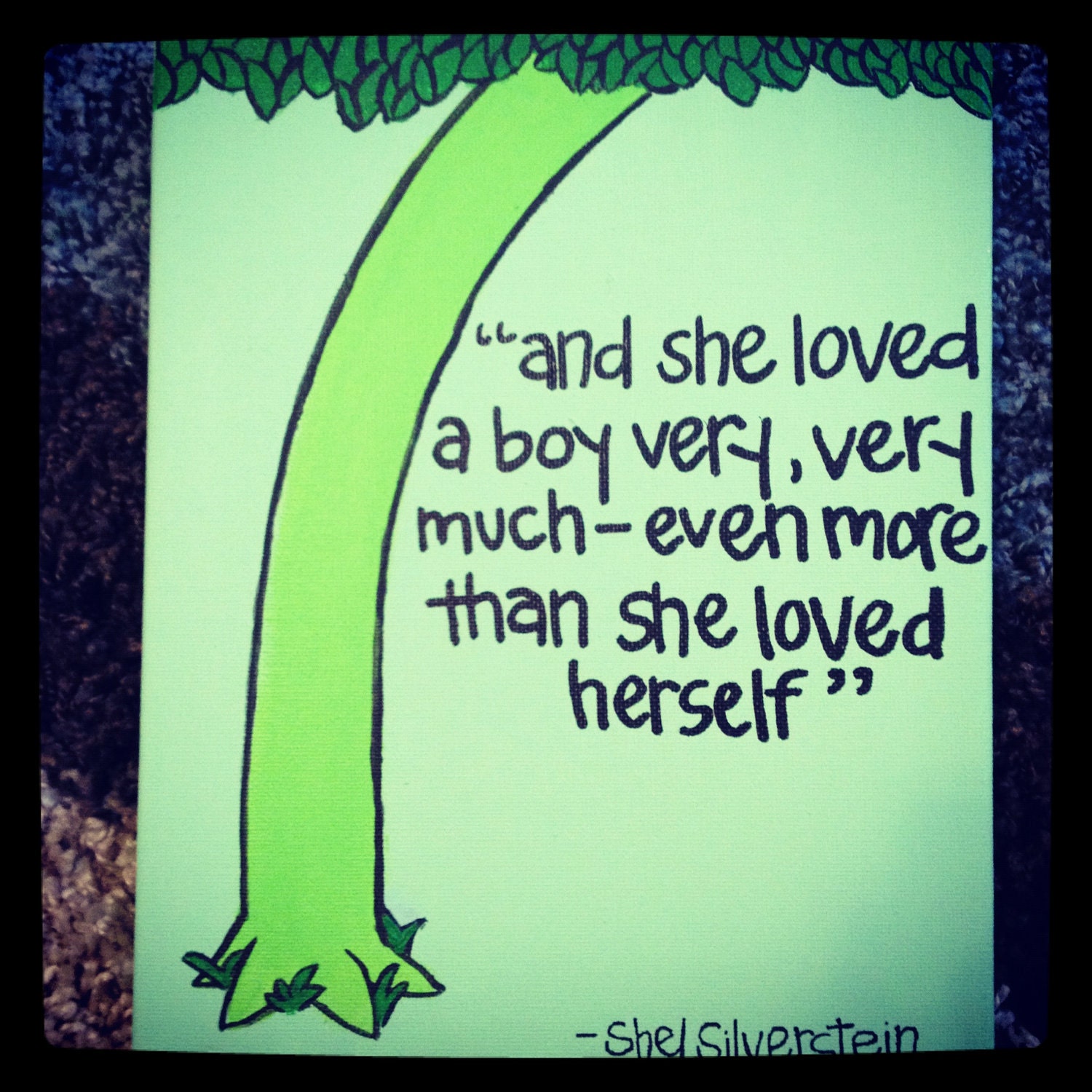
But can you ever do enough? No.  Sometimes I feel like I should hook a line up to my veins and just let the students drain the life out of me.  I'm sure my institution doesn't explicitly conspire to exploit my love of students, but it would undoubtedly benefit from its staff and faculty all to be like the fucking Giving Tree, never drawing a line in the sand to say, "I've given you all I have. How can you possibly want more?"

Let me be clear, this situation is not the students' fault, and that's the purpose of this post.  I resent being asked to be a Giving Tree while the institution cuts all kinds of supports for students, reduces staff support, enacts all kinds of "efficient" budget-cutting strategies, and leaves students without forms of support that they once had.  It seems there's all kinds of "creeping" here: faculty and staff (and even students) are being asked to provide supports where once the infrastructure did.  While student mental health issues rise across colleges students nationally, students are increasingly coming to college with all kinds of traumas (intergenerational, veteran, sexual, you name it).  Some call these students "underprepared," but it's really the institution that is underprepared for the new face of college student.


Don't ask me to solve budget problems with more love. It's pissing me off. Love isn't free, you patriarchal nincompoops.  Now I'm getting wise to the albeit probably unintended strategy.  Sharp as a tack, this feminist. Yup.

So, the institution is, understandably, going to take the path of least resistance.  Not maliciously, I know, it leverages my love for teaching and for students in hopes to increase retention and speed students across the finish line.  Cha-ching.  Guilting me into loving them more is easier and certainly cheaper than providing students basic needs, so they can come to class ready for our academic work.

(I'm increasingly shifting focus away from academic content and more to survival strategies for students, as a result. Anybody else?)

You can put a dollar sign on hiring more therapists, or adding another staff member in student affairs. So those can't be added to a cut budget. But you needn't bother counting "love."  Just keep the guilt trips coming, and all that great data on the transformative impacts of faculty love, and you'll keep extracting love from faculty.  After all, it's all we got.  It's what we do. It's our calling. It's our identity. It's the only way we can feel we matter in the world. We're suckers.  At least, I am.  After all, I'm a woman and a mother and so I can't resist a little trip on the guilt train of not loving enough.

As feminists have long argued, love is the most exploited of our labors.  Love is natural, free, unquantifiable, and selfless.  Right?  As a woman, I know love is expected more from female teachers, and I'm the worst culprit.  I do love my students, but that's not what's at issue here. What is at issue is how my institution leverages that love for its own ends while not supporting students in their psychological needs, housing, adjusting to being in a rural, predominately white town, etc.

Make no mistake, dear reader, this is about the politics of care.


Thank God she's smiling. I almost felt sorry for her! She must love this!
This brings me back to research. In my most resentful moments, I envy my research-oriented colleagues for being valued for their labors, for their institutions not pressuring them to love their students more (on the contrary, those colleagues' love of teaching is hidden in the R1 closet).  The gendered aspects of this current state are not lost on me. Research is valued work in those settings, while and teaching isn't, just as public is to private, or job is to housework, as male is to female.

But here, because HSU is a teaching institution, if you leave our "home" to do work outside-- e.g. research or professional service beyond the boundaries of this house-- you're abandoning the family.  I sometimes feel like doing research is to my HSU family the way working away from home is to my nuclear family.  Both make me feel guilty, that I'm not providing direct care, and so therefore I'm being selfish.

That is, I get the sense that my love of research may be perceived by colleagues in my institution as taboo; I'm not sacrificing enough to meet all the (students') needs on campus.  When I hole up with my computer to write, no matter how relevant or interesting that writing may be to students intellectually, I'm indulging.  If the work doesn't directly meet their material or emotional needs or can be tied in some measurable way to "student success," good luck getting any respect, support, or value for it.  If it doesn't result in the deliverable that the institution wants-- graduation, or other statistically measurable metrics of "student success", then it's superfluous.

So now I'm starting to empathize with those curmudgeons from my first job.  Perhaps it's not that they didn't love teaching.  Perhaps it was that they were sick of being asked to give, give, give without some giving on the part of the institution. Some quid pro quo.   And perhaps they wanted more recognition that the work that sustains them-- teaching, but also research and meditation, professional leadership and dancing (e.g. non-student-interfacing work)-- is just as important for so-called "student success."

It's one thing that an R1 might undervalue teaching. But my institution is a self-avowed teaching-centric place. So it's all the more egregious that the thing I love-- teaching-- gets undervalued here (not unlike housework, eh?).

Don't tell me that if I loved it, I'd do it for nothing.  Don't tell me to love students more, so our graduation rates can improve, which will get us more resources from the state, which will trickle down into some form of relief... somewhere down the line.

What evidence do I have to trust this promise?  Why should I keep sacrificing myself in the name of love for students when students keep losing various forms of structural support?  Why should the onus of providing these supports creep into my workload, just because I love my students?


Ok, enough complaining. Time to get constructive.

What would it feel like to be supported by (instead of resentful of) my institution in my love for my students?

Oh, let me count the ways.... Any combination of 2 or 3 of these would be an improvement:

  1. adequate psychological and health services for students
  2. adequate and nondiscriminatory housing for students of color
  3. being asked, "what would you need to feel supported?", then see follow-through-- even if that follow-through is "sorry, here's why we can't do that."
  4. explicit follow through on any number of the thoughtful suggestions outlined by several devoted faculty and staff in supporting minority and/or female students, faculty, and staff. (If you're interested, one is a letter with detailed suggestions written by concerned faculty after the tragic and race-motivated murder of one of our black students, Josiah Lawson, on April 15, 2017.  About a year earlier, our director of the African American Center for Academic Excellence, John Johnson, also compiled a list of brilliant requests from students in a document.  Despite detailed, concrete requests drafted by a major student-led movement in 2014/5 responding to the abrupt firing of a beloved Native American staff member, Jacqueline Bowman, very little has been done, to my knowledge. These impassioned and thoughtful letters serve as roadmaps for the administration, should it really choose to act in accordance with its stated mission. Argh.)
  5. action on any number of the brilliant items under "diversity and inclusion" in our recent Strategic Plan.  It's a thing of beauty. I'm really proud that HSU has created such a beautiful ideal. I'm committed to working with HSU toward these ideals.
  6. that the campus community at large feel that the administrative leadership hears and is following through on requests to support them better
  7. professional development resources (e.g. how to address the fact that students' basic needs are encroaching into the classroom)
  8. not ask faculty to do contradictory things (e.g. implementing a "writing across the curriculum" initiative while increasing class size, or work-creeping the jobs of recruitment, development, website management, course enrollment analysis, or alumni relations that used to be done by units/staff that no longer exist, while also asking us to learn new software and related forms of assessment, make us fill out multiple evaluations about everything that happens on campus, but never close the loop.... You get my frustration here.)
  9. Provide somebody competent and full time in our college who can work on development, so we can make our own money to compensate for the ways that the state is cutting staff and other forms of student and faculty support
  10. Provide a full time person who can manage the college's websites, so we're not asked to do so
  11. Provide a full time person in the college to advise all our first years in the basics of understanding their degree audits
  12. Hire upper administrators who aren't trying to glide through the last five years of their careers, and so actually care about accountability, faculty morale, and the community of the campus
  13. improve vertical communication accountability; administrators shouldn't behave as if they're in a vacuum.  Student and faculty concerns should receive responses, even if nothing can be done about them. 
  14. Don't get rid of things that really work, like our Institute for Student Success, and our Office of Diversity and Inclusion, and, and, and.... (WHY, oh why? And why didn't you tell us why?) You're killing me.
  15. Take responsibility for structural reasons that students aren't succeeding, instead of telling me I need to love them more.  That really kills my morale. Can you tell? I'm a lover, people.
If any of these things are already happening, then I want to know, and I want to celebrate the awesomeness of my institution!   So WHERE IS THE TRANSPARENCY??? Why don't we know that the institution is doing such awesome work to fix these problems?  Maybe I missed the memo. Perfectly possible.  But we need university-wide morale lifting, and I think sharing these successes in about 20 memos wouldn't hurt.

(Update from a few days later: I learned that the HSU Strategic Plan folks have a great website to track progress.  That's fantastic, and I'm proud!!!  What I would like is also the sense of community narrative around this-- e.g. the "20 memos" concept-- that doesn't require we each individually bookmark the Strategic Plan webpage in order to know what's happening.)

(Update from an email from our President following her Fall 2017 Convocation: YAY! Look at the things the institution is doing!! I'm pleased that there's some progress, and even more pleased that this memo went out to all of us.  A break in the vacuum, perhaps? Let's hope!)

(Update from Fall 2017 convocation meetings: the institution is developing a Center for Teaching and Learning that will provide a lot of the kind of support I'm asking for here, I hope!  So far, no website to link yet, but I've already started getting my first emails about "teaching tips" etc..  I look forward to working with them to support the students and thereby all of us).

******

I'll never get so cynical that I stop loving.  bell hooks taught me that.  But for reals, peeps.

Any suggestions about how to keep on loving without losing yourself?