


I love you. The thought of you sometimes makes me choke up with pride. You are like a big down comforter. Just knowing you're there makes me feel warm. Before I met you, I thought I was alone. I didn't think the word "community" applied to anything in my life. Now, I feel like one small but important node in a vast spiderweb, an invisible force holding the world together, together. Thank you for manifesting yourself. You, the blessed unrest, my tribe, are the silver lining.
All loves also entail friction. I want you to be your best self. And, I can't be with you all the time.
45 isn't the hurricane you think he is; he's just the weathervane. Melania's jacket is abhorrent, but it's not that she doesn't care. She's mad at him too. In what universe is that jacket a feminist statement? Try to get your head there. Female anger emerges as a whack-a-mole.
 |
| Don't get me wrong. I am not apologizing for that shit. But look at her. She's pissed. |
If the evidence results in revealing that the emperor has no clothes, what then? Will we be satisfied? Will our triumphant moment of justice make everything OK?
No. America has been ripped open, and with the pump of each day's news, it bleeds life out. Focusing on those with political power is like wrangling with telltales. Holding the flimsy strands of fabric in the place you want them won't change the direction of the wind.
And we will tire of the battle. Arms aching, teeth gritted, we'll burn a fuse with all that anger directed at flaccid nothingness.
The real work is tending to the culture wars. Tribalism is everywhere, dividing, dividing, dividing. Disguised as solidarity, we build ourselves up by what we're against, leeching our life-force out, day by day.
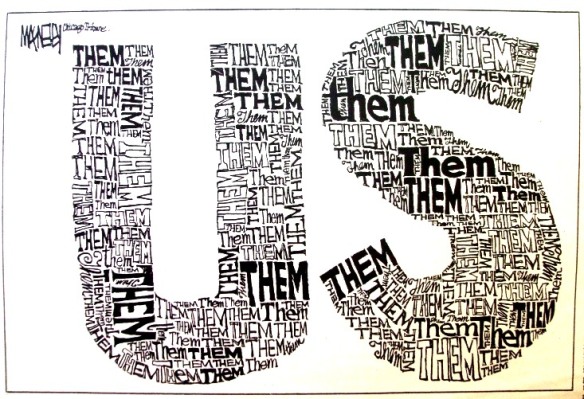
Before 2016, I thought that having more arguments, evidence, and facts in my back pocket was the way to move the dial of our culture in the directions I wanted. Likewise, as a teacher, I had thought my role was to fill students with knowledge to support positions and claims, arm them with reason and teach them how to win debates.
Has this worked in my most intimate relationships? No. Fifteen years into my marriage, I am finally learning that winning arguments and locating blame may feel temporarily good, but acts like herbicide in a garden. Only one thing can grow under the reign of repeated exposure--resentful victimhood. Our own relationships reveal this truth to us.
Beware the us-them mindset; the other side entrenches further too. Utopia isn't around the corner of a few changed offices. Silencing the other side by winning arguments and races can not remain the holy grail of your political energies. When my lover argues me into a speechless corner, my resentment finds other outlets. My heart and mind are not changed. Victimhood becomes fuel for other fights.
I would like the weathervanes and telltales to indicate a different wind, for sure. I love you, tribe, for figuring out multi-issue politics, intersectionality, and strategic coalition-building. I love you for all you do. I worry for your longevity, and I worry about what happens to the country when you win.
If you don't see me at the next march, it's not because I don't love you. I'm wrestling the wind, not the weathervane.
Love,
Sarah

 In contrast, she said, deceleration, degrowth, is a praxis of environmental justice. The "logic of 'not-enoughness' is disabling to activism." In other words, the overwhelming feeling we all have to increase the amount of work we do in response to the increased urgency and onslaught of crises is not sustainable to the "marathon" (Bullard's word) of environmental justice.