Most-Read

Showing posts with label motherhood. Show all posts

Tuesday, October 2, 2018

Kavanaugh, Climate Grief, and Babies

There have been a spate of news articles of late that comment on the fact that millennials are choosing not to have children because of climate change.

Image result for millennials not having kids

Self-regulating to control population growth for the sake of the planet is not a new concept.  One need only to Google "overpopulation" to learn all about how the planet's woes can be solved by what you do with your uterus. Please, let's not pretend that vaginas have nothing to do with environmental politics.

As a feminist who also cares about the environment, I, too, have struggled with the question about whether I should reproduce and become one of those dreaded "breeders." I've read, and even published on, the complicated dilemma of being an environmentalist and a mother. Having a child is the worst thing you can do to supersize your ecological footprint. Environmentalists rage over whether having kids is a deal-breaker, or whether those who advocate for reproductive justice (often women, and often women of color), and those who advocate for the environment (often white people, and often men) need to play better together. This post is not about whether having kids is good for the environment, and I'm definitely not interested in telling anybody what to do with their uterus.

I won't rehash these debates here, but they serve to show how the new discussion about abstaining from reproducing is so different. The new argument is not about whether you'll add another person to an already burdened ecosystem.  It's easy to see why that goal might seem lofty and only appealing to elites. No, now it's about whether you can handle the grief of bringing people into the world who will experience it dying. That's a whole different existential question, if you ask me.

I'm of a generation that had children in the transition between these two rationales. By the time I had my second child, in 2014, I had stuck my feminist finger up at the populationist Malthusian fascists, but was fully immersed in a bad case of eco-grief.

Why did I have a second child? Total emotional and cognitive dissonance is my answer. But I can assure you that not a day goes by when I don't agonize about the world my children will grow up in, and I'm not just talking about politics. I mean the extinctions, the loss of beauty, the spread of toxins, cancer, and pathogens, and the geopolitical insecurity (and fear and nationalism it spawns) that climate change is already putting into motion. Forget polar bears, I cry regularly for the world their generation will inherit.

As couples of all sexualities and gender identities enter that time of life when they're trying to figure out whether they want to do that old-fashioned thing of "settling down and having kids", many of them are saying "hell no" in order avoid the guilt and grief of voluntarily foisting the next hideous 50 years of Anthropocene hell on their offspring.

But, I dare say, their abstention isn't just about the environment or love of their children. It's also a middle finger to the heteronormative, nuclear family fantasy. For many hetero women, the stakes are are high. In general, these women still do the vast majority of domestic labor, which goes up exponentially when you add kids. In general, these women are still paid 75 cents to a man's dollar, and even less for women of color. As a professor, I'm sure my students are watching me juggle home life and a career-- a great privilege, I concede!-- and thinking, "hell no. Not for me."

And frankly, I support them, especially my female-identified students. I'm sure that I shock them when I brazenly provoke them to imagine not having children, or at least doing so with eyes wide open about the costs. As someone who may appear to be a model for "having it all," and as someone who is fairly high-functioning, I may be hard to believe when I say I find my "life-balance" borderline impossible, and share the real stories of how my mental, physical, and marital health have taken some bad hits. Why would I wish this on anybody? I want to send alerts to future me-types from this side of the line, saying "don't come this way, too many booby traps!"

I'm not trying to be ungrateful. I just wish someone had sent me the memo when I was young that I could fulfill my maternal destiny by birthing many loves*-- books, intellectual work in the world, mentoring students, friendships, supporting my parents and other family members, the list goes on and on-- and not just actual babies.

Today, my partner asked me, "how will we tell our girls that they don't need to have kids?"

I've been rehearsing that answer in candid conversations with my students for years.  Here's what I said to my partner, without even thinking about it.

Let's tell them at an early age that their self-worth is not dependent upon others' views of them.

Let's tell them that their futures can include any number of fates that don't entail parenting (I never start any sentence with "when you grow up and have your own kids, you'll...").

Let's tell them that their power in the world is not derived from who they're related to ("someone's mother, daughter, sister") but from her own solo self.

Let's tell them that pleasing other people --be they potential partners, children, or their own parents--is not the only thing that will define their social value.

Sure, you can tell your daughters about the coral reefs and the rising sea levels, and fear-monger about climate refugees and the coming anarchy. Heck, try giving them a copy of The Population Bomb! for their 13th birthday.  But personally, as a feminist, I like to think that their empowerment as women is tied to the liberation of others, including other species, and that it doesn't require the suppression of their or anybody else's reproductive rights.

I may have made a different choice by marrying a cis-man and having kids, and it may seem I'm being hypocritical by saying these things. I know I'm walking on eggshells here, because I don't want to speak for all women, nor all hetero/nuclear family moms. And I know that my issues reflect my relative socioeconomic and racial privilege. I know these are not every woman's issues, for sure. I am also extremely grateful for my life and have no regrets. And obviously, as if it needs to be said, I love my kids. I wouldn't want to impose my choice to have kids on anyone else, just as I can understand why some people would disagree with me that having kids is still really oppressive for many American women. It's both/and. Having kids can be awesome, and also can be a personal journey through patriarchy. Furthermore, people who have kids sometimes care more about the future of the environment than they did before (this was certainly the case for me, but then of course having kids increased my footprint by ridiculous levels), but that doesn't mean that people without kids are likely to care less, and all of this is totally shaped by cultural upbringing, class, etc. etc. I concede all these eggshells I know I'm walking on. My arguments here admittedly are shaped by my perspective of being a white, hetero, cis, PhD-wielding, American woman.

All that said, when I was young, I did not get the message that I could be a whole and loved person, without children. It's taken having kids and navigating the brutal demands of work and domestic life in a heteronormative context for me to realize that "having it all" (kids+ career) isn't the only way for women to fulfill their purposes in the world. Only as I mature into mid-life do I realize that I have value as a human being outside of my ability to reproduce, parent, support a partner, and fulfill this dream of normalcy.

To me, the news that young people are thinking about not having kids is both tragic and fabulous. I am happy for them that they'll never go through watching their kids realize how bad things are, that they'll never feel that guilt and heartbreak. I also imagine all these women liberated to pursue their myriad loves-- first and foremost, themselves. I see all this patriarchy loosen its grip, because having children still so seriously constrains women's voices, choices, and ability to chart their own course.
But of course, I see the tragedy too: I wouldn't want my reproductive choices to be influenced by how much carbon will be in the air by the time my kids are adults. So I am sad for them, even as I'm giddy about what it will mean for rearranging sexual power relations. What will happen to all these things when fewer women are involved in "traditional" marital relations, having fewer children, and start to see their sexual and political identities in all these new ways? Oh my!

Whenever I think about young women making decisions about having kids, I don't just think about the planet, or their kids' potential future eco-grief. I think about young women's self-worth being measured by other things, things of their own determination, things outside the conventional nuclear arrangement--an arrangement that is frankly neither pro-environment nor pro-woman. I think of my girls living different childhoods than I lived, where their sense of self-worth eclipses what men think of them, and where their choice to potentially not have children won't feel like the same loss for them as it would have for me.

Like many of you, I am despairing about what I'm watching these past few days about Brett Kavanaugh's bid for the Supreme Court. As an environmental studies professor, as a feminist, and as a mother, I can't separate my desire to see ecological doom averted from my desire to see the next generation of women redefine the contracts of partnerhood, domestic life, and sexual power.  Gender relations are undergoing tectonic shifts right now. My hope is that both the planet and women will gain much from all these changes.


_________________

*Yeah, I am referring to Rebecca Solnit again. Her book, The Mother of All Questions, is inspiring to me, but I can't wait for the book that tells me how to do what she's doing, and also have kids. I guess that's the point-- it's still really hard to do both.

Friday, May 18, 2018

The Myth of the Selfish Woman

I've been thinking a lot lately about the paradoxical feelings of motherhood, like selfish vs. sacrificing, and love for others vs. loss of self.  We are all supposed to have stable, monolithic feelings about mothering, and if we dare veer from that one acceptable feeling-- unconditional, self-sacrificing love-- then the world seems to fall apart.

Forget adultery. In this age, it seems the worst thing a woman can do is be Selfish, branded with the scarlet letter S in a world that relies on women seeing their only value in terms of the love they give others. Indeed, the root of "martyr" is of course, mother.

So many women I know feel ashamed to share that they feel anything negative about mothering, as if those negative feelings would somehow counteract or negate the positive they also feel. They are to feel complete and fulfilled by manifesting their destiny as mothers, and when they express doubt or resistance to this notion of motherhood, they're damned.

Can't we feel opposing things equally and simultaneously? Doubt and certainty? Fear and adoration? Anguish and intimacy?  Can we not desire intimacy with our own selves as much as we desire intimacy with those around us?  Why is it so abhorrent to think of mothers as as much internal as they are external in their attentions?

The problem with this approach to mothers is that it actually hurts all women, not to mention the kids and the partners and everybody else around them.  This expectation that women should feel ultimate fulfillment and love by mothering is destructive for mothers and non-mothers alike.  It creates a situation where women who choose to mother are shocked to find they miss themselves and struggle for years to figure out how to find themselves again--all in isolation because of the shame they feel for daring to have any other feelings besides love. It makes women who do not mother-- for whatever reasons, intentional or not-- subject to suspicion.  Rebecca Solnit writes about this in her book, The Mother of All Questions (which of course is, "why did you choose not to have kids?"), for example.  It marks women who want but can't have, or who lost, children as walking embodiments of Tragedy.

The lack of open discussion about the complexity of women's feelings about themselves and about their desires or lack thereof to procreate, and stigmatizing all feelings non-loving around motherhood,  eats away at us.

I see so many of my mother friends suffer from this. Many of our partners add to the shame. And it's easy to see why. The notion that a mother would have complex feelings about motherhood is quite a threat. If mothering isn't totally fulfilling to my partner, will she leave us? Have an affair? Damage the children for life? I have yet to meet a mother who feels her partner can allow the space for negative feelings about mothering. That pressure, too, especially from one's most intimate partner and supporter, amplifies the sense of isolation and shame tenfold.

I feel both fully fulfilled in some profound existential way by the experience of having and raising kids. And I am also feel profoundly claustrophobic because of the inescapability of the daily demands on me, and anxious about the alternative paths I'd also like to be exploring.

It's truly a practice in surrender, and even if there is something appealing about this assault on my desiring ego in a kind of Buddhist way, I don't like it.  I feel both daily explosions of love for my kids and family life, and also daily pangs of resentment about the obligations they put on me. I feel both intense desire to spend more time with my kids and also an intense desire to do a million other things--alone-- that I feel I was put on the planet to do.

It's no surprise to me at all, given the current arrangement of American family life, where there is no village to help me raise my kids, that many women would choose not to have children.  Structurally, it's hard to imagine mothering and also pursuing any other thing fully, except perhaps in sequence (phase two of life = raising kids, phase three = becoming a monk, running for president, starting your own commune, what have you).

These "other loves" as Solnit writes about them, are not compatible with having children.  Her book is all about either/or: women who don't have children devote their loves elsewhere (which is awesome), while women who have children devote their love to their children.  So much for "having it all," right?  I certainly think of myself as devoting myself in many directions, but have been called on multiple occasions,  "selfish", implicitly or explicitly, for doing so.

The ways that married and parenting life curtails self-actualization are a constant source of angst for me.  And yes, perhaps some really brilliant women can self-actualize while mothering.  Every moment with my kids is heavy, full of life, vitality, and profound sense of immediacy and intention.  I also love that, even as I want to focus that way on other things too.  These bonds are both oppressive and fulfilling. Isn't this the paradox of relation?

Perhaps when we accept all the feelings, normalize all the feelings so mothers and non-mothers alike feel no shame or isolation in their myriad devotions, then maybe mothers can find the sacred in the daily grind of life with kids, and see their pursuit of fulfillment as tied to that of non-mothers.

There are so many people and places to devote one's self to, it needn't always be one's children. We can make kin in so many ways, as feminist writer Donna Haraway would have it. We should also be able to retract into our own selves, turn that love inward, and replenish our reserves on occasion, without thinking we're being selfish by doing so.

When we start to see that all of our pursuits are admirable, not selfish, we know we're getting close. Because it's so easy as a woman to internalize the message that our purpose is to please others-- this message is everywhere.  And I don't want my daughters to receive this message, not the least of all from the life I model for them as their mother and as a woman with many other loves. Any woman who can transcend that message deserves a medal, not the scarlet letter S.
Image result for selfish woman

Monday, April 23, 2018

The Vacuum

I'm trying to get my head around the fact that on April 11, 2018, my gorgeous, capable, creative, and pregnant step-niece, mother of three young children, hanged herself.

My head is cracking open at the mental exercise of trying to grasp this information. My rudimentary understanding of mental health-as-illness, as opposed to a matter of will power or choice, is barely a consolation. My brain hurts, my heart hurts, my throat hurts, my womb hurts.

Her suicide feels like an asteroid has ripped a hole in the atmosphere, leaving everybody who knew her gaping open in agony. It's like what happens in airplanes when their windows rip out and everything inside gets torn to shreds in the nothingness that roars through. With great sorrow, I imagine her children and husband like passengers in the airplane, ripped out the windows of the sweet, beautiful life she painstakingly created for them. All of a sudden, even oxygen feels like a luxury. The hole left behind is heavy, irrefutable, dark, and empty.

Despite a challenging childhood, thin on many forms of crucial support, she built a dream life for herself, of which I was frequently envious. She mindfully manifested the world we could only dream of for her. She was extraordinarily crafty, making aesthetic DIY projects out of free items on Craigslist, creating a labyrinth of raised garden beds producing vegetables, flowers, and blueberries, and making fairy houses through the woods with her kids.  She adopted animals and friends into her life, generously giving of her energy to lots of living things that needed nurturance.

I know all mothers love their children, but she made mothering a mission. She planted so many seeds in the world, despite having been deprived of essential nutrients in her own childhood. Did she keep filling up the world with love and beauty in order to fill a hole inside herself? How could all that love and creativity be only directed outward, and not toward filling her own emptiness?

She and I weren't very close. But she was one of the most important people to somebody with whom I am very close-- my stepmother. Their relationship had its ups and downs, to be sure, but nobody held a firmer place in my stepmother's heart than this young woman. My stepmother did her best to be a loving, stable force for her, and to perhaps fill her own holes through that relationship. They had many reasons to hold tightly to each other.
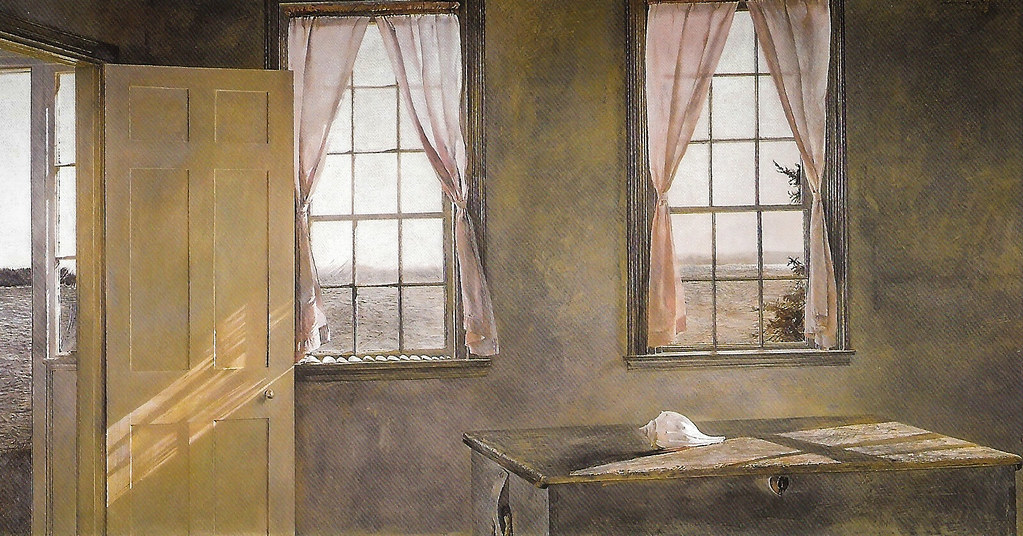
Image result for andrew wyeth maine art
I'm thinking a lot recently of Andrew Wyeth's hauntingly beautiful Maine images. As I look at "Her Room", I imagine my step-niece there. I gather she saw Maine as her escape from suffering. I imagine her in a room like this right now, at peace.
At the memorial service last week, at least 150 friends and family descended on my step-niece's idyllic northern California home. Her little children and her husband, having slept elsewhere for the previous week, came back to the garden she had spent the past several years building, came back to the critters and tiny-house dwellers on their property--friends from high school and from the ever-spiraling-out rhizome of a community my step-niece cultivated--and to the blueberries just ripening on the spring bushes.

In a poignant gesture of normalcy, the little girls squealed with delight at the sight of the first green, tiny blueberry of the season, which had come into being during their week of absence, during the week since their mother had been found. I can't decide if the marching on of nature is an insult or a comfort. How can they keep growing without her?

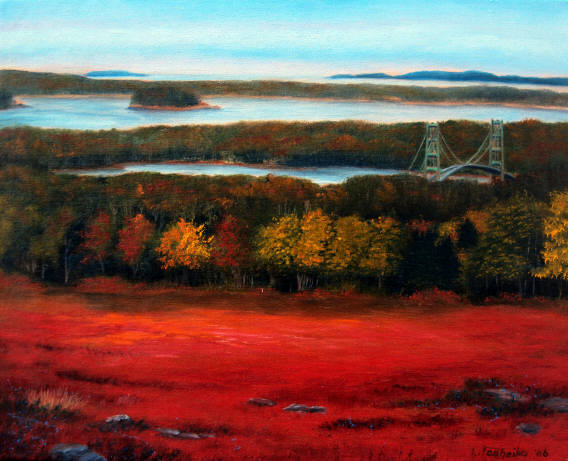
Image result for caterpillar hill blueberry field
Anybody who knows my step-niece knows that her love of blueberries started in Maine. These are blueberry fields in autumn, a view from Caterpillar Hill looking at the bridge to Little Deer Isle, where she spent a month each summer with my dad and stepmom. Despite her seemingly idyllic California life, she had bought a house in Stonington and was planning to move there soon.

Then I try to think of all the things she put into the world-- babies, blueberries, beauty-- and take some small comfort in knowing that although the vacuum is still tearing through the lives of those she left behind, so much of the love she created will come into being for years to come.