Most-Read

Showing posts with label climate justice. Show all posts

Friday, July 6, 2018

Teaching, Climate Change, and Eco-Grief: Recent Talks

I have been excited, nervous, and honored to give a few talks this past year on eco-grief, climate change, and teaching undergrads in the Anthropocene.  I thought I'd collect links to them in one place.


  • December 2017 University of Washington. Thanks to the Interdisciplinary Anthropocene Cluster for inviting me. The talk is available on You Tube, here.

  • February, 2018. "My Favorite Lecture" series, Plaza Grill, Arcata, CA.  Thanks so much to Mike Dronkers for the incredible editing and organizing work to make this sound so good. Available as podcast here.

    Image result for sarah ray ucsb
  • March 2018, Swarthmore College (my alma mater). Thanks to one of my idols, Giovanna Di Chiro, who I'm so grateful to for inviting me there. It was lovely to catch up with my religious studies professors from my time as an undergrad, Mark Wallace and Steve Hopkins. The audio and transcription are available here.

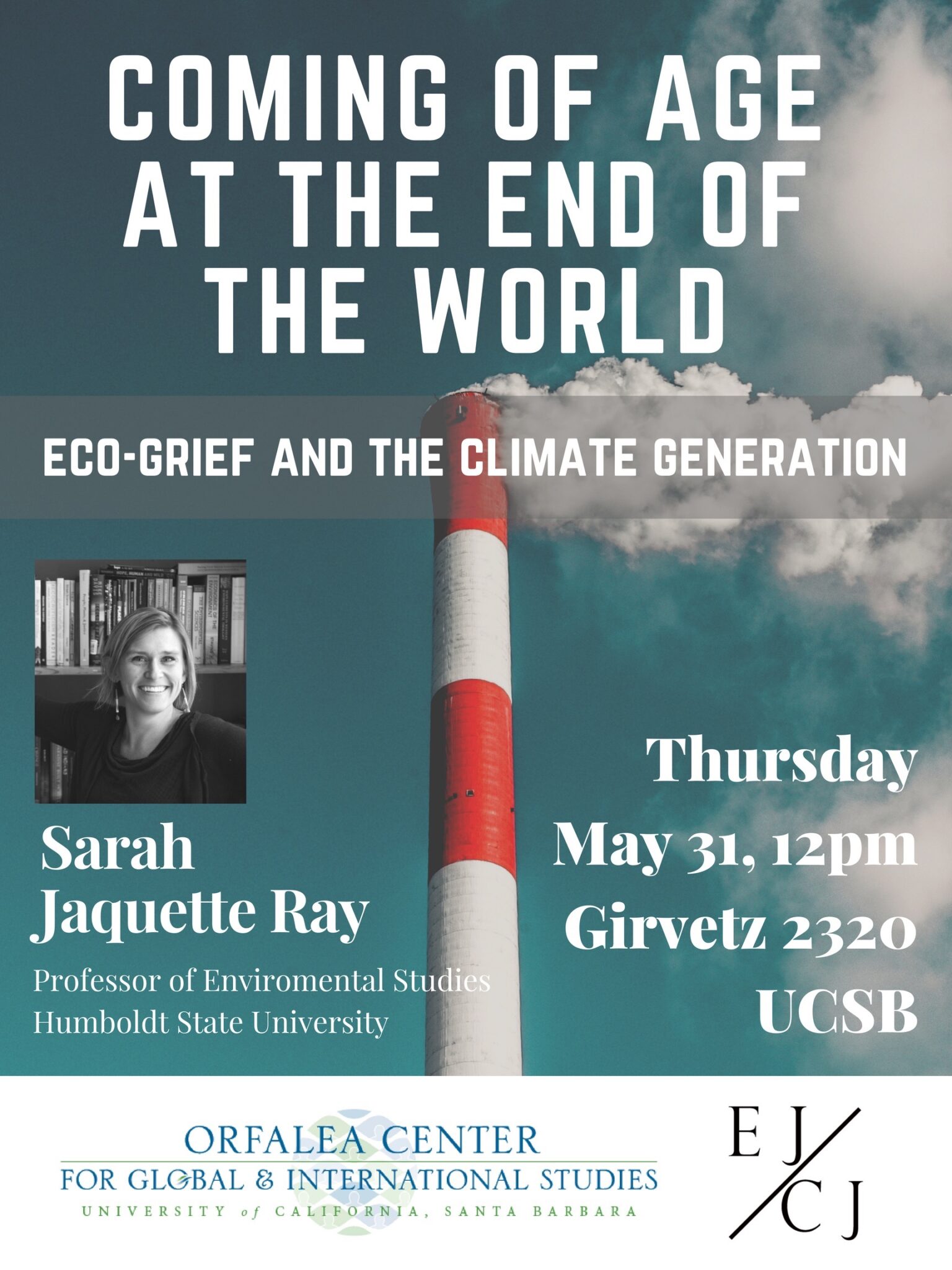
  • June, 2018, University of California Santa Barbara. Thanks to John Foran for inviting me to join the Environmental Justice/Climate Justice working group for inviting me.  


Image result for affective ecocriticisms


A new book coming out Fall 2018, Affective Ecocriticism, edited by Jennifer Ladino and Kyle Bladow, features the only published article-length version of this work, but I'm currently developing these ideas into a book project. 


Tuesday, October 24, 2017

Where is Decolonization in Environmental Justice?: Jaskiran Dhillon's Critique

I learned about the work of brilliant activist-scholar, Jaskiran Dhillon, at the Human Rights symposium in St. Louis October 11-12, 2017, the subject of my last blog post.  Dhillon is an assistant professor of Global Studies and Anthropology at the New School, and is from a tiny town in Treaty Six Cree Territory, Saskatchewan.   Raised by politicized parents, she quickly became involved in decolonial activism, and does this work across the globe, particularly in Canada and Burma and, recently, in solidarity with Standing Rock.  Author of Prairie Rising: Indigenous Youth, Decolonization, and the Politics of Intervention, Dhillon gave a plenary talk at the Human Rights symposium that developed an anti-colonial critique of environmental justice. 

A couple of random highlights:

·      Voicing a position I have a hard time conveying to my environmentalist students, Dhillon is suspicious of the new craze to integrate Traditional Ecological Knowledge (TEK) into Climate Change science and policy.  She reminded me that TEK is not a knowledge “resource,” as the language in the documents of federal agencies describes it, but rather an action word—it’s something that people do, not know.  The language of TEK as “resource” sets up TEK to be yet another thing to colonize for the purposes of settler-culture’s desire to adapt and survive climate change.  The “discovery” of the value of TEK on the heels of centuries of assimilation and oppression attests to the fact that settler culture only cares about indigenous ways when it suits their own agendas.  The potential for abuses of TEK and the communities that embody it—in the name of dominant white cultures battling or surviving climate change, while indigenous communities continue to bear the brunt of extraction politics—are high.  Dhillon asks, “whose interests are served when TEK is extracted in service of climate recovery?”, and says the problem is that the appropriation of TEK to protect “all of us” is not linked to the broader goals of indigenous sovereignty or dismantling settler colonialism.

·      Environmental justice (EJ) isn’t a useful term for indigenous movements, in part because it identifies the first race-based environmental abuses in the 1970s, with Love Canal and as documented by Robert Bullard’s Dumping in Dixie.  The origin story of EJ in the US ties it to the Civil Rights movement, whereas indigenous communities have been experiencing race-based environmental exploitation “since 1492.”  Also, for indigenous communities, colonization is above all an act of environmental violence. If we historicize the 1970s as the birth of EJ, we yet again erase indigenous history in the U.S. Alternatively, maybe EJ is just something else—not just a way to describe links between racial injustice and environmental degradation.  I think Dhillon might argue that settler colonialism’s own forms of environmental degradation ought to be described as its own thing. But it’s still really helpful for her to have pointed out the need for a more specific, precise definition of EJ so that colonialism isn’t ignored, yet again, and so that we can understand the nuances between different forms of racial injustice and their often quite different relationships to environmental degradation.  Another way of approaching it, she says, is to consider decolonization as a foundation to EJ.

·      Dhillon also made the brilliant point that climate change and settler colonialism are linked.  This may feel like a “no-duh” insight to those who study or live TEK, but this insight is really important as a follow-up to the above point: dominant environmental discourse often posits that industrialization (e.g. Leo Marx, Al Gore) or capitalism (e.g. Naomi Klein) are the root causes of climate change.  An anti-colonial critique of this narrative points out that colonialism paved the way for these later developments, and that ongoing colonial relationships enable these other phenomena to thrive.  Overthrowing capitalism or getting post-fossil-fuel won’t address the root problem.  Dhillon says that blaming capitalism is “a red herring.”  As such, a person can be fighting for fixing climate change and also be very much against indigenous sovereignty.  To take it further, I would add that this is precisely the kind of internal contradiction within the mainstream environmental movement that often assumes its “saving” of the planet will lead to social justice. 

·      Dhillon also writes about, but did not develop so much in the talk due to time limits, the links between NODAPL and police state violence, indigenous education policies, “man camps”, sex trafficking, and myriad other forms of cultural, physical, and sexual violence.   As she says, “NODAPL isn’t about a pipeline; it’s a fight for the co-existence of life.”

In the Q&A, Dhillon received a final question from an older white woman, who asked, voice quivering and nearly on the edge of tears: “I love my house.” Long pause.  “What are we supposed to do?”

I just about combusted in my seat, and wondered how Jaskiran would handle this.  She was a master class in difficult dialogue.  I wish I could relay precisely what she said, but basically, she firmly but calmly said, “that’s not my problem.  Find resources about how to work through your white guilt, find friends going through the same thing, and figure it out.  Start to see all the privileges you inherited so that you could have your house; this work is hard.”  She was firm about not coddling the white woman’s newfound epiphany of her complicity in colonialism, but did not punish her for asking the question.  I asked Jaskiran what she thought of that exchange, and I was really impressed that she welcomed the question and commended the woman for saying what so many people think, but fear saying.  


I’m still mulling over all that happened at that conference, but certainly Dhillon’s talk and her Q&A taught me so much about the messiness of the relationships between the climate movement and decolonization, and between EJ and indigenous rights. 

Saturday, June 24, 2017

Grappling with Despair in the Classroom: An ASLE Roundtable

At the Association for the Study of Literature and Environment conference this year, I organized a roundtable on climate justice pedagogies, and brought together some powerful instructors and one student to talk about how to deal with the depressing effects of studying environmental crisis and injustice.  Told to "save the planet, kill yourself," and observing our leaders undermine environmental and social justice, how do we expect the next generation to find a reason to live?


One of my students depicted his response to my class, ENST 295: Power, Privilege, and the Environment, with this fabulous Valentine's card: "This is your brain on ENST 295."


The roundtable extended a conversation prompted by SueEllen Campbell’s pre-conference ASLE workshop on teaching climate change at the 2015 conference in Moscow, ID, as well as LeMenager, Hall, and Siperstein’s new groundbreaking resource, Teaching Climate Change in the Environmental Humanities.  That superb volume doesn't outright engage affect theory, but every single piece speaks to the challenge of overcoming students' despair.  In my experience, students' affective response to the material I teach about structures of power and environmental injustice can become a barrier to learning.  I wanted to hear how my colleagues were addressing this challenge.


Covering experiences teaching in places from Georgia to Singapore, in a diversity of institutions from conservatory to land grant university to technical college, and to undergrads in majors ranging from music to engineering to composition, not to mention environmental studies, I gathered six participants who prepared talks responding to the following questions:
  1. How are you dealing with students' eco-grief, environmental despair, and even nihilism when they learn about climate change & environmental justice? 
  2. What is a justice-inflected pedagogy, and how might it add to climate change courses? 
  3. What is an affect-focused pedagogy, and how might it add to environmental or climate change courses?
  4. How does a climate justice pedagogy add to teaching climate change?
  5. What do you do with "hope" in your classes?
  6. How does the Trump era shape your pedagogy?
Other themes emerged, too, and I was glad to hear respondents talk about acknowledging that different students will respond to the material in different ways depending on their positionality.  In other words, students who have been experiencing environmental injustice in their lives are not shocked by the content.  I took note that I need to address this much better in my pedagogy.  

Jenn Ladino, an associate professor of English at the University of Idaho, opened the roundtable with some provocations and guiding questions. She asked, how can affect theory help explain emotions related to environmental change and loss, including new affects that are emerging in/with the Anthropocene? How is affect transmitted across scales, from individual to global and vice versa? What are the prospects for empathizing across species, and across temporal scales?  She argued that we need to attend to a wider range of affects in texts and classrooms, as well as some new ones that are emerging in the Anthropocene: climate grief, Anthropocene anxiety, solastalgia, even irreverence and humor, which I'm excited to learn more about in Nicole Seymour's book-in-progress, Bad Environmentalism.  

Jill Gatlin, faculty at the New England Conservatory of Music in Boston, argued that a justice-inflected pedagogy requires enabling students to understand their positionality and privilege vis-à-vis the unequal distribution of climate change consequences. However, emotional reactions to explorations of privilege may range from defensiveness to denial to guilt.  Jill described a course she taught that asked students to consider climate change's effects on a place that they are connected to, in order to make it more real to them.  As musicians, Jill's students also explored what "action" in response to climate change and injustice would mean. 

Robert Melchior Figueroa, an associate professor of philosophy at Oregon State University, argued that "academic cowardice" in this moment makes the assumption that students can't handle the truth.  He insisted that students can handle the emotional intensity of how terrible things are, and that a new vocabulary of affect is crucial for working through this with them: environmental guilt, environmental shame, environmental paralysis, environmental anger, environmental complacency, environmental complicity, and environmental honesty.  Importantly, Rob talked about the importance of exploring students' environmental identities and heritages for grappling with the doom-and-gloom with them.
 

Independent scholar Melissa Sexton provided a beautiful description of how she integrated this material "sideways" in composition courses with technical college students. She should run workshops on this. In contrast to Rob's provocation for us to get more honest, Melissa talked about the need to not alienate students.  She proposed that the concept of the Anthropocene is an easier one for students to engage without getting polarized into the tired old climate change sides.  She can get students to think critically about complicity, justice, technology, ethics, etc, with conversations about the Anthropocene, whereas climate change as a concept can shut down students' ability to think and learn.

Matthew Scheider-Mayerson, assistant professor at Yale-NUS Singapore, talked about the challenge of teaching climate change in that country.  In Singapore, a wealthy illiberal democracy with no recent tradition of social movements, he finds that the pedagogical path that had succeeded in the United States – guiding students from complacency to awareness to outrage and a desire for engaged citizenship and political action – was far less successful.  He argued that instructors model affective responses, intentionally or not, and vulnerability, grief, and honesty become important in the classroom. The typical posture of cautious optimism is not the ideal orientation, he argued.  Like others on this roundtable, he suggested that we sit with the grief with our students, even as we find ways for them to channel their desire to solve problems, act, etc.
 
Finally, a recent graduate of the Environmental Studies program I lead at Humboldt State, Carlrey Arroyo Delcastillo, spoke from her experience as a student of color in a predominately white institution.  It was this talk that really prompted me to think about the ways in which the affective journeys of the white students in my classes dominate my own design of the class.  Attending to white fragility, shock at their privileged complicity, apathy about whether they can/should really save the world as they had hoped, and tears over all the evil in the world, can be silencing to students who have different affective responses to the material.  Carlrey talked about her journey toward a social justice approach to environmental activism, and ended with something like, "it's ironic that I went into environmental studies because I hated humanity, and now my work is based on my love for it."  I'm pretty sure there wasn't a dry eye in the audience.  And what a way to end-- on love.

The room was packed. People were lined up against the walls.  It indicated to me that instructors of environmental and climate justice are desperate for pedagogical tools to help students grapple with this material.  My colleagues and I are worried about our students-- the next generation of people who are inheriting this mess.  

How do you deal with emotion in your classrooms?