Most-Read

Showing posts with label climate change. Show all posts

Friday, July 6, 2018

Teaching, Climate Change, and Eco-Grief: Recent Talks

I have been excited, nervous, and honored to give a few talks this past year on eco-grief, climate change, and teaching undergrads in the Anthropocene.  I thought I'd collect links to them in one place.


  • December 2017 University of Washington. Thanks to the Interdisciplinary Anthropocene Cluster for inviting me. The talk is available on You Tube, here.

  • February, 2018. "My Favorite Lecture" series, Plaza Grill, Arcata, CA.  Thanks so much to Mike Dronkers for the incredible editing and organizing work to make this sound so good. Available as podcast here.

    Image result for sarah ray ucsb
  • March 2018, Swarthmore College (my alma mater). Thanks to one of my idols, Giovanna Di Chiro, who I'm so grateful to for inviting me there. It was lovely to catch up with my religious studies professors from my time as an undergrad, Mark Wallace and Steve Hopkins. The audio and transcription are available here.

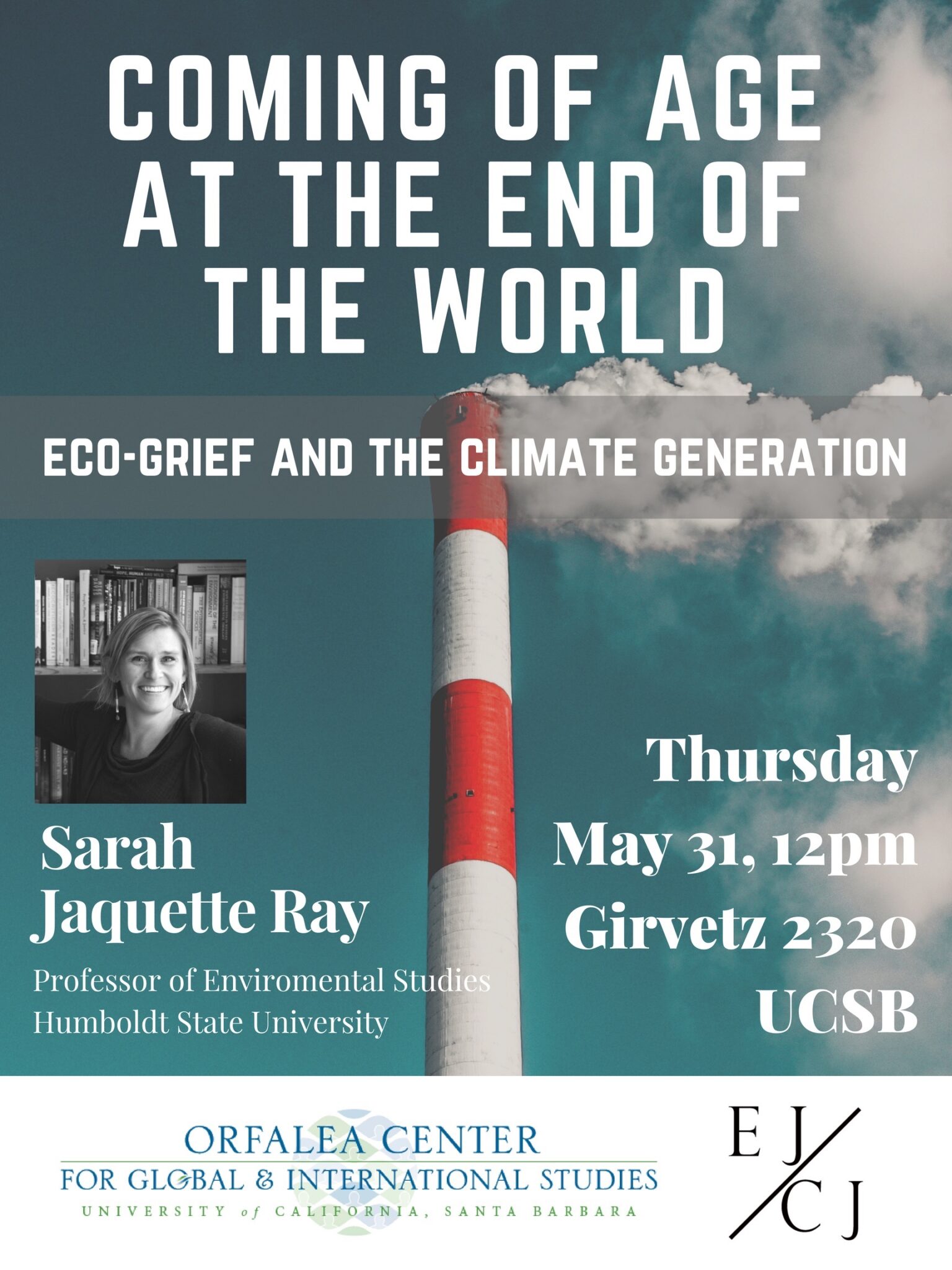
  • June, 2018, University of California Santa Barbara. Thanks to John Foran for inviting me to join the Environmental Justice/Climate Justice working group for inviting me.  


Image result for affective ecocriticisms


A new book coming out Fall 2018, Affective Ecocriticism, edited by Jennifer Ladino and Kyle Bladow, features the only published article-length version of this work, but I'm currently developing these ideas into a book project. 


Tuesday, October 24, 2017

Where is Decolonization in Environmental Justice?: Jaskiran Dhillon's Critique

I learned about the work of brilliant activist-scholar, Jaskiran Dhillon, at the Human Rights symposium in St. Louis October 11-12, 2017, the subject of my last blog post.  Dhillon is an assistant professor of Global Studies and Anthropology at the New School, and is from a tiny town in Treaty Six Cree Territory, Saskatchewan.   Raised by politicized parents, she quickly became involved in decolonial activism, and does this work across the globe, particularly in Canada and Burma and, recently, in solidarity with Standing Rock.  Author of Prairie Rising: Indigenous Youth, Decolonization, and the Politics of Intervention, Dhillon gave a plenary talk at the Human Rights symposium that developed an anti-colonial critique of environmental justice. 

A couple of random highlights:

·      Voicing a position I have a hard time conveying to my environmentalist students, Dhillon is suspicious of the new craze to integrate Traditional Ecological Knowledge (TEK) into Climate Change science and policy.  She reminded me that TEK is not a knowledge “resource,” as the language in the documents of federal agencies describes it, but rather an action word—it’s something that people do, not know.  The language of TEK as “resource” sets up TEK to be yet another thing to colonize for the purposes of settler-culture’s desire to adapt and survive climate change.  The “discovery” of the value of TEK on the heels of centuries of assimilation and oppression attests to the fact that settler culture only cares about indigenous ways when it suits their own agendas.  The potential for abuses of TEK and the communities that embody it—in the name of dominant white cultures battling or surviving climate change, while indigenous communities continue to bear the brunt of extraction politics—are high.  Dhillon asks, “whose interests are served when TEK is extracted in service of climate recovery?”, and says the problem is that the appropriation of TEK to protect “all of us” is not linked to the broader goals of indigenous sovereignty or dismantling settler colonialism.

·      Environmental justice (EJ) isn’t a useful term for indigenous movements, in part because it identifies the first race-based environmental abuses in the 1970s, with Love Canal and as documented by Robert Bullard’s Dumping in Dixie.  The origin story of EJ in the US ties it to the Civil Rights movement, whereas indigenous communities have been experiencing race-based environmental exploitation “since 1492.”  Also, for indigenous communities, colonization is above all an act of environmental violence. If we historicize the 1970s as the birth of EJ, we yet again erase indigenous history in the U.S. Alternatively, maybe EJ is just something else—not just a way to describe links between racial injustice and environmental degradation.  I think Dhillon might argue that settler colonialism’s own forms of environmental degradation ought to be described as its own thing. But it’s still really helpful for her to have pointed out the need for a more specific, precise definition of EJ so that colonialism isn’t ignored, yet again, and so that we can understand the nuances between different forms of racial injustice and their often quite different relationships to environmental degradation.  Another way of approaching it, she says, is to consider decolonization as a foundation to EJ.

·      Dhillon also made the brilliant point that climate change and settler colonialism are linked.  This may feel like a “no-duh” insight to those who study or live TEK, but this insight is really important as a follow-up to the above point: dominant environmental discourse often posits that industrialization (e.g. Leo Marx, Al Gore) or capitalism (e.g. Naomi Klein) are the root causes of climate change.  An anti-colonial critique of this narrative points out that colonialism paved the way for these later developments, and that ongoing colonial relationships enable these other phenomena to thrive.  Overthrowing capitalism or getting post-fossil-fuel won’t address the root problem.  Dhillon says that blaming capitalism is “a red herring.”  As such, a person can be fighting for fixing climate change and also be very much against indigenous sovereignty.  To take it further, I would add that this is precisely the kind of internal contradiction within the mainstream environmental movement that often assumes its “saving” of the planet will lead to social justice. 

·      Dhillon also writes about, but did not develop so much in the talk due to time limits, the links between NODAPL and police state violence, indigenous education policies, “man camps”, sex trafficking, and myriad other forms of cultural, physical, and sexual violence.   As she says, “NODAPL isn’t about a pipeline; it’s a fight for the co-existence of life.”

In the Q&A, Dhillon received a final question from an older white woman, who asked, voice quivering and nearly on the edge of tears: “I love my house.” Long pause.  “What are we supposed to do?”

I just about combusted in my seat, and wondered how Jaskiran would handle this.  She was a master class in difficult dialogue.  I wish I could relay precisely what she said, but basically, she firmly but calmly said, “that’s not my problem.  Find resources about how to work through your white guilt, find friends going through the same thing, and figure it out.  Start to see all the privileges you inherited so that you could have your house; this work is hard.”  She was firm about not coddling the white woman’s newfound epiphany of her complicity in colonialism, but did not punish her for asking the question.  I asked Jaskiran what she thought of that exchange, and I was really impressed that she welcomed the question and commended the woman for saying what so many people think, but fear saying.  


I’m still mulling over all that happened at that conference, but certainly Dhillon’s talk and her Q&A taught me so much about the messiness of the relationships between the climate movement and decolonization, and between EJ and indigenous rights. 

Friday, August 11, 2017

Scaling Up: California Climate Justice Knowledge Action Network


This past 9 months, I've had the honor of being the California State University representative on a statewide collaborative called the UC-CSU Knowledge Action Network for Transformative Climate and Sustainability Education and Action (or KAN, for short). Yeah, it's a mouthful.  But don't hold that against us.  This was one of the best professional experiences of my life yet, its long name notwithstanding.

You can check out the above link to find out more of the history and structure of this network, but in this post I want to talk about the highlights, for the purpose of thinking about the potential these kinds of networks hold to fuel our lifework.

The main reason I got involved was because I have been desperate to feel that the work I'm doing at my own institution and in my own teaching/research can have a broader impact.  I've written scholarly articles and books, and reach many students, but for some reason--especially on November 9, 2016-- I felt the need to magnify the work I have been doing to integrate social justice into environmental conversations, to increase interdisciplinary collaborations, and to spread the gospel of liberatory pedagogy.  Anybody else feel that way?  I hear some amens.

I had also been doing some research on emotion and environmental grief (see my previous posts for more)-- a dimension of teaching environmental studies that, I would argue, we must take much more seriously if we're going to reach students and equip them for the world they're growing up in.  I thought this was fluffy, feelings-stuff, but it turns out that, when I put this interest front and center of my application to the KAN, plus my passion for thinking about climate and sustainability through a justice lens (as opposed to natural science or engineering), I drew the attention of the organizing committee as a possible CSU-wide representative on the planning team.  I couldn't say no.

A chance to share these problems and resources about classroom affect and environmental justice with experts around the state?  Sign me up!

Over the spring 2017 semester, I met with groups of amazing, inspiring faculty around California over the course of four workshops, and learned a lot about myself, our shared problems, institutional barriers to interdisciplinarity and students from underrepresented groups (what the CSU calls Underrepresented Minorities, or URM).  I sat in rooms with natural scientists, planners, Chicano/a Studies scholars, and others from a variety of fields; what we had in common was passion for climate/sustainability and teaching/pedagogy, a feeling of urgency for these topics in higher education in California, and a sense that social justice should frame these discussions.

Some questions we agonized over were:
  • How could we accelerate and improve our climate justice/sustainability pedagogy?
  • What strategies and resources could we leverage to do more interdisciplinary work? 
  • How could we engage our communities more for building climate resilience and just sustainability? 
  • What kinds of pedagogical strategies could we use to include more students in environmental work?
  • What kinds of privileges are we bringing to the table that may get in the way of these goals?
  • What vision for change do we hold, how do we prioritize them, and what are practical steps we can take toward those changes?
To our great fortune, our workshops were facilitated by Abigail Reyes, whom I've written about in another blog post. I can't begin to describe the transformative experience of being facilitated by this woman; it was perhaps one of the most important parts of participating in the KAN for me.

It gave me newfound respect for the vocation of professional facilitation, for one, and it made me rethink my pedagogy-- perhaps I could run my classes as Abby ran our workshops! What would THAT entail?  Good grief, I really have begun to think this through, and have made it a goal this semester to practice her strategy in one of my classes.  Just to see.  What would happen if we treated our students like people with a shared set of concerns who need to solve some problems and find their agency in the world?   What a radical concept!

Besides the love I developed for Abby, facilitation, my co-planning team members, and the state of California, I also gained some of these insights:

HSU Doesn't Suck As Much As I Thought

My own institution, besides disappointing me time and time again on its inaction and lack of follow-through around issues of diversity/inclusion, and despite its deplorable idiocy and ass-backwardness on so many fronts, I actually came away from the KAN workshops with a great sense of appreciation for Humboldt State.  The main reason is because, even though we suck at so much, at least we think we care about social justice and environmental responsibility.  After all, it's in our mission.  We may not know how to do that, but at least we hold ourselves to some accountability around those concepts.  We don't have as much of a hill to climb to change hearts and minds on our campus around those topics.

Graduates from HSU can elect to take the "graduation pledge", which has been a model for other institutions around the country.  Great place to teach environmental studies from a social justice perspective, right? Yes, of course, but also, it's an ideal, not always a reality...

Relatedly, HSU rewards community-based and justice-centered research methods, radical pedagogy, public intellectualism, and interdisciplinary and/or student-based research.  Unlike some R1s, or other kinds of colleges, these values really are part of our retention, tenure, and promotion (RTP) standards, and I hadn't quite realized how big a deal that is.

I've Already Accomplished a Lot: Chillax More, Girl!

The KAN validated many of the efforts I've already been making in my post as the first program leader of Environmental Studies, a major that started in 2012 at HSU, and which I've been tasked to build from the ground up. Some of those important changes are:

  • to develop a service-learning senior capstone that engages students in community problems and gives them a sense of efficacy
  • to integrate professionalization and career development in my classes so students feel their skills are valuable and know how to "sell" them
  • to find ways to co-teach and promote interdisciplinarity among the ENST affiliated faculty in other ways
  • to draft RTP standards that reward all of these radical forms of knowledge production and pedagogy, instead of reinforcing the colonizing tendencies and ongoing corporatization of higher ed
  • to add courses that emphasize the social change agent and social justice aspects of environmental studies in the curriculum. 
So, even though I have been working on these things, the KAN helped me realize that these are worthwhile efforts, and that what we've done at HSU can really be a model for others.
I'm no expert, but this is what I think chillaxing looks like in Humboldt County.

But Don't Get Too Lazy...

Yet, so much more to do!  My experience with the KAN told me that I would like to devote myself more to building relationships rather than adding lines on my CV.   I am again grateful that I'm at an institution that values those relationships over big-time, top-tier publications, and so I should take advantage of that. I want to collaborate more with people on my campus to improve student success, but also to co-teach more, create more interdisciplinary dialogue, and work more with student affairs/services.  Not that I have any time, but I did put these goals on the horizon as next steps.

  1. Preach it! Get public! The KAN made me think hard about how to make the intellectual work of environmental intellectuals-- especially humanists and social change theorists-- more accessible.  Some ways we can do that are: publish more open-access stuff, value easier-to-grasp writing styles and venues, give more talks in the community and in the world.  I bought the book, The Public Professor, to help me with this, and I am going to get some training on how to give better talks. If I could figure out how to make a website to make my work accessible, I would. That's on the list.  Also, I agreed to do one of those "My Favorite Lecture" things in our town, even though I fundamentally disagree with the power dynamic there-- that I, an expert from the hill, would slum it with the peeps in the community to enlighten them, rather than the other way around, which is really what we need to do more of.  
  2. One way we can get more public is to get savvy about press releases about our work, and learn to work more closely with our media folks.  Check out a press release about the KAN's culminating virtual conference here. And of course, our final KAN conference, where all the members report on their best practices and goals, is publicly and freely available here, thanks to Ken Hiltner, a UCSB environmental humanities dude who is pioneering a "nearly-carbon-neutral conference" model.
  3. Pie in the sky: I thought that a social change agent boot camp based on Abby's facilitation process would be awesome to have a few weeks prior to classes starting.
  4. I reinvigorated my goal of developing a GE class that teaches self-care for social change agents, e.g. "How To Be A Change Agent in the 21st Century" or "Self-Care for Social Change Agents".  Eh? Sound good? Thumbs up?
  5. Do the work that fuels me, and not just all the work that needs to get done.   I want to write a book. I love to write. Hence, this blog.  The KAN helped motivate me to write this blog.
  6. My hope from ending things with the KAN for now is to continue working with John Foran, whose support and collaboration are fueling, though it does disappoint me that he can't match my margarita-swilling prowess.   Check out his climate justice work here
I have many more things on my 'to-do' list after working with the KAN, but for now I feel the buoying sensation of expert, passionate faculty across the state supporting and magnifying these efforts. I feel our shared resources enabling our efforts, and I rest more easily--rather than in a constant state of despair and impotence-- that I'm not alone in thinking all of these things are important.  I like knowing that we're all out there, pushing California in all these little ways.

So, I'd love to hear more from you:

How are you scaling out your own work?  
Where do you find your resources? 
How do you use the annoying apparatuses of your institution in your favor to address problems?   
-

Monday, June 5, 2017

Does Environmental Studies Need Science? A Polemic

I know that's a provocative question.  Spoiler alert: obviously, we need science.  But read on: it's complicated.  Studying the environment is not the domain of scientists-- nature itself is at stake when we assume so.

Let's start with a few vignettes of weird science/studies moments in my career, to set the stage:

- In grad school, a student I TA'ed for thought that "science was in the driver's seat, social sciences was in the passenger seat, and the humanities and arts was in the back seat" of some proverbial environmental studies car.

- I just completed an external review of the Environmental Studies program at my institution, which I lead, and despite about 20 other programs existing on our campus that do variations of environmental science, the review stated that our program--the ONLY one in the College of Arts, Humanities, and Social Sciences-- should collaborate more with and integrate more sciences.

- Whenever an article gets written in our student newspaper about what environmental studies students are doing (e.g. collaborating with the Art department to create an environmental photography course, or collaborating with journalism to make climate change PSAs), environmental "science" gets the credit, just because everybody confuses environmental sciences and environmental studies, and thinks they basically do the same thing anyway, so who cares.

- My neighbor keeps asking me things about biology and ecology because I have a PhD in environmental studies.  I don't know shit about the lifecycle of that bug, dude.

- Colleagues keep asking me to help them out with science.  Sarah, can you come lecture about climate science to my class?  That would be funny.

- Colleagues who do work in social theory or critical race/gender/colonialism studies always dismiss me as a tree-hugging, deluded, unsophisticated positivist.  Secretly, sometimes, it makes me want to whisper assurances in the hallway, "I hate science.  Shhh.. Don't tell anybody."  Actually, I'm always saying this: "I'm terrible at science. I have no science background. I'm sorry I can't help with your science need."

- Students interested in the environmental studies program here always want to get their hands dirty, get in "the field," and save the planet one species at a time, or so it seems.  But they are bad at and/or hate science and math.  Is environmental studies a good fit for them?  HELL NO!  Who do you think we are, watered-down, easy, wannabe environmental science?

- When my students make appointments with the career center to discuss grad school, internships, etc, they get assigned the science advisor, which helps them NOT ONE BIT.  In fact, it just amps up their anxiety that environmental studies won't get them any jobs, that they don't fit anywhere, their newfound skills have no value, etc. This is really damaging.

-  In recruitment, advising, and marketing, misrepresenting environmental studies as "like environmental science, with less math" is not only inaccurate, and not only does it shortchange the awesome other stuff we do, but it just repeats back to prospective students that non-science/math skills are worthless, and if they pursue them on their path to save the environment, they are not doing good enough work.

You may be thinking by now that I have a complex, a chip on my shoulder, about being mistaken as an environmental scientist, and the program I lead and the students thriving in it confused for environmental science.  Ok, I may be a bit annoyed.  Let me rephrase that.  It really bugs me.  I'll tell you why.

Let me begin by assuring you that I do not actually hate science.  I am married to a scientist, and nearly everybody in my family is a scientist.  As an interdisciplinary scholar, I value science more than the average person.  There are so many reasons we need to advocate for science right now, no joke.  Science is under attack, and I don't want my critiques or grudges to just add fuel to the conflagration against truth and facts going on in current debates about climate change, the dismantling of the EPA, etc. etc. Scientists, I am with you.

However, I do want to examine some of the assumptions I take issue with when people confuse environmental studies for environmental science, assume the studies field is just a watered down, wannabe science, or tell me I need more science to make my work credible. I love scientists, but the study of the environment is not just about nature "out there"-- ecosystems and plants and weather and carbon cycles.  Anybody who believes as much is perpetuating the dichotomy between humans and nature that got us in trouble in the first place.

Problematic Binaries
Hard vs. soft knowledge
Male vs. female
Thought vs. emotion
Mind vs. body
Human vs. animal
Applied vs. Theoretical
Action vs. Speech
Knowledge vs. Imagination

Need I say more?

Information-Deficit Myth
When we say that we need more science to make our work more robust, we are implying that more quantitative or "hard" information will help us do something better.  It may help us think better, and we may need more science to make the work more robust. But robust, actionable ideas don't always need science, and when it comes to thinking about how to tackle climate change and global environmental injustice, in fact, I would argue that we don't need more science.  Kari Norgaard does a great job in her fantastic book, Living in Denial, showing that the lack of action around climate change does not have to do with lack of information.  Even scientists the world over are saying, "more information won't make people change their minds".  This "information deficit model" that underpins the arguments for more science fail to see that our problems are fundamentally social and political.  Figuring out how to change society, alter political will, envision sustainable futures, critically analyze scientific claims about the environment, and develop resilience at the individual and collective scales will all require imaginative, cultural, political changes.

How can we move the dial on these domains?  The non-science-based environmental studies fields, such as environmental ethics, environmental history, environmental justice, environmental humanities, environmental art, environmental sociology, not to mention all kinds of non-academic bodies of knowledge.

Back-Seat Driving
Going back to that godawful metaphor about the artists in the back seat, I want to also challenge the assumption that scientists are producing primary knowledge and information, while the artists and humanists' job is to communicate that information to the public, to get more people to care about it, and to generally be the cheerleaders for the scientists who are doing the real work.  I love cheerleading scientists, don't get me wrong, but do you see the problem here?  This idea that humanists and artists have value only to the extent that they do the work of communicating, of changing "hearts and minds," is a very limited notion of what they do-- also known as the "translation model."  Humanists and artists are creating their own original forms of knowledge about nature, for one.

Further, the conceit that science is not objective truth, existing outside of social meaning, political power, and historical context. Scholarship analyzing the relationship between science and art in terms of how they affect cultural knowledge is robust. I'd recommend checking some of it out.  CP Snow's Two Cultures, Nabhan's Cross-Fertilizations, Latour's We Have Never Been Modern, Harding and Figueroa's Science and Other Natures, Donna Haraway's work, Peter Bowler's History of the Environmental Sciences, the list goes on and on.  Then there's all the critical science studies coming out of indigenous studies, feminist studies, and cultural studies.

It is just so egregiously uninformed to assume that culture--the area of study of social sciences, humanities, and arts-- isn't itself producing the lenses through which we even come to think about science as truth.  To put it another way, culture makes science, not the other way around.  When people assume that there's no difference between environmental studies and environmental science, they're ignoring all the ways that science is imbricated in culture, and the real material impacts that culture has.

Positivist Conceit: Science as Knowledge/Power
Which leads us to the question, Who's an agent of knowledge? Why do we surrender truth to experts? Within what kinds of institutions/structures are these people deemed experts?  What about power and politics in determining who gets to be an expert on the environment?  Here, I love Timothy Luke's essay on Environmental Studies as Eco-Managerialism, in which he uses Foucault's ideas of power/knowledge formation to rip apart the use of environmental science fields as a way for capitalism to commodify all nature.  I wouldn't myself go that far, but it's a provocative essay to teach, and gets to this point well.

When we assume that environmental scientists are the only ones who have anything true to say about nature, that they're in the driver's seat so to speak, we devalue all the other claims to truth about nature that ever existed espoused by anybody else.  We perpetuate power relations of the status quo and say that some kinds of claims about the environment or nature are valid while others are not.  How do you think this pans out for all kinds of disempowered, oppressed groups?  Why do you think environmental science is such a white field? Oops, did I say that out loud?

Environmental Studies is Doing Something Different
Do you want to know what we're doing over here in environmental studies, and why I'm kicking up such a stink about how all that work gets either ignored or coopted when you fail to distinguish between environmental studies and environmental science?  Ok, I'll try to summarize in a short paragraph the entire purpose of an entire suite of fields, from environmental humanities and environmental justice to ecocriticism and eco-media studies and eco-art, and environmental political theory and queer ecological studies and critical technology studies and critical geography and ecofeminist theory and traditional ecological knowledges, and... Hang on, let me catch my breath.



Environmental non-science studies has some stuff it wants to do that's important. Loads of people have explained this better than I will here.  Try seeing the vimeo video on the environmental humanities, or Astrida Neimanis' essay on four problems/directions, for starters. But to be really basic, the non-science kind of environmental studies seeks to achieve these things:

  1. help us understand political, geographic, cultural, historical, emotional, and economic contexts within which environmental problems arise, are framed, and are addressed as such
  2. help us imagine, using this knowledge, better futures
  3. give us tools to understand how environmental issues are entangled in other problems
  4. help us understand how identities are entangled in environmental ideas, so that we can cooperate on environmental things better
  5. help us grasp how social justice/power structures interplay with environmental problems and claims
  6. tell different stories about the environment to change existing power relations 
  7. using scholarship, provide us with the affective tools needed to face problems, with attention to positionality and difference
Just to name a few things...

And you can see why science may be helpful in all of these goals, right?  YES, we need science to do some of these things.  I'm not rejecting science!!!  Let me repeat. Cultivating a strong knowledge of how science operates in culture and across history is not a rejection of it.  This isn't the same as not "believing" in evolution or climate change.

I'm saying, please don't confuse these goals with what science is doing, and please stop giving scientists credit for our work. We are DOING DIFFERENT THINGS. Sometimes those things are complementary, and sometimes they're in healthy tension.  That's good. It's called the marketplace of ideas. It's good.

Students of environmental studies need to get over their environmental-science envy, or their science-inferiority complex as I like to call it, and get down to the business of doing some awesome work and awesome thinking.  Bring in some science, sure, but be thoughtful about which science to bring in, and when.  Scientific literacy is really important here, for sure.  But to suggest that the science that environmental studies students need is oceanography, or wildlife, or earth systems, is to repeat all kinds of troubling assumptions about what the environment is in the first place.  Why not toxicology, epidemiology, or citizen science?  What about TEK?

When we make claims about needing environmental studies to be grounded in science, we really have to think carefully about what knowledges we're privileging, which sciences we're implying are needed, and what definition of "the environment" we're perpetuating.

After reading this, I hope you might actually confuse a few scientists with me, see how that shakes down.  "So, you're providing a roadmap for a just and sustainable future, based on critical analysis of how we got in this pickle? Oh no, you're counting bugs? Oops, sorry, I confused you for someone who is actually in charge of driving this car."  That's obviously over the top, and I apologize to all my beloved science colleagues and friends reading this, but the reversal of roles does reveal the irksomeness, eh?

So, the answer to the question is, our need for science depends entirely on the question we're asking.  I'll boldly state also, that sometimes, for some of the biggest questions we need to answer these days, experts in culture, identity, power, politics, history, discourse, and justice have a huge role to play in the climate movement.