Most-Read

Showing posts with label books I'm reading. Show all posts

Saturday, July 8, 2017

Got Umwelt? A Children's Book that Will Blow Your Philosophical Mind


Animals have long been a major theme of children's books.  Animal studies critics historicize the beginning of this phenomenon, bemoaning the resulting infantilization of animals.  When children and animals become so closely associated, at least in the Western imagination, they are both demeaned, according to these critics, at least: animals become like children, and children like animals.

Having observed my own two children fall in love with reading, books, and their imaginations, not to mention animals, through children's books, it's hard for me to resist a great children's book about animals. But I'm particularly moved when I find a book that does justice to both animals and children.  They All Saw a Cat, by Brendan Wenzel, is one such book.
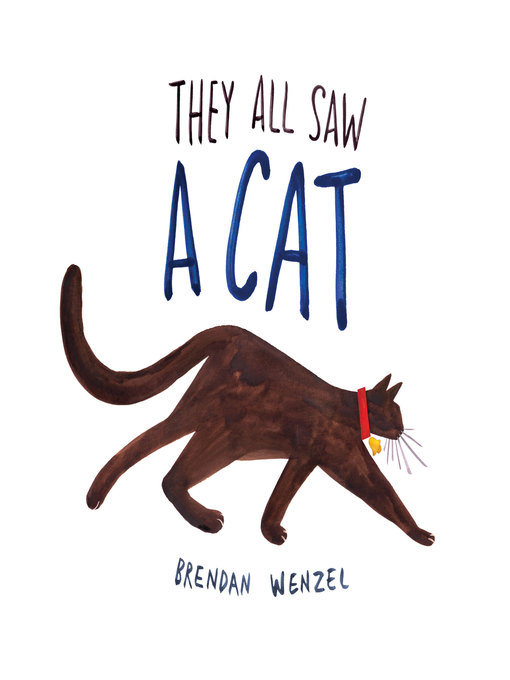


Got Umwelt?

The whole premise of this very simply written book is that all kinds of animals perceive the cat in all kinds of different ways.  The illustrations are evocative of a diversity of umwelts, or worldviews, to use Jakob von Uexküll's term.  Each page shows a different animal perceiving the cat, and each illustration evokes the unique possible ways that those different animals may perceive the cat.

So, for example, the worm might only perceive the cat through vibrations it feels underground as the cat walks above.  The illustration of this page shows only lines underground in the shape of a cat, surrounding the worm.

The bee sees a bunch of colored dots that make up a cat face.  The fox mostly hears a cat, right?  So it "sees"* in the illustration, at least, mostly a bell hanging around the cat's neck.  How about a bat?  It "sees" the cat as echolocation, of course. How would you represent that in a visual illustration?  In the book, it's a bunch of dots in the night that make the shape of a cat.  We "see" (or feel, or hear, or sense) the cat from the perspective of a snake (represented by the illustrator in infrared), a child, a bird, a bee, a flea, etc.
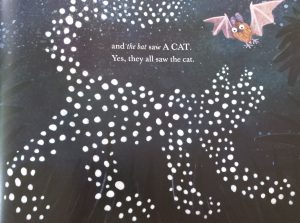

How would a bat "see" a cat? 


From the perspective of animal studies, this is precisely the kind of appreciation of animals we need more of in the world.  The reason for this is because animal studies critics don't like the fact that most Western representations of animals project human qualities or desires onto animals instead of seeing animals as potentially carrying their own perspectives, desires, and intelligences.  In most children's books, this means that animals play supportive, secondary roles to the child or human in the story.  They are blank slates on which to play out the drama of human needs.

They All Saw a Cat totally rejects that Western trope of the animal in children's books. It asks readers to imagine perceiving the world through all our senses, like so many animals do.  It demands that readers imagine what it would be like to go through the world as a bat, or a snake, or a bee, or even a worm.  In other words, it simultaneously asks readers to transcend our hubristic humanism that universalizes experience and knowledge of the world, and to put themselves in the place of each of these animals.  Through the worm, we learn what it might feel like to be anybody but ourselves.  This is the most important foundation of empathy.  Surely, if we're going to exploit animals in children's stories, this would be the right reason.


How would a fish "see" a cat? Watery and huge, looking at it through the fishbowl glass!


Of course, our protagonist is the cat, who walks through each page, encountering each of these animals.  After meeting a few animals, the cat gets its own page again, anchoring the reader in its perspective.  Every few pages, we read again, "And the cat walked through the world, with its whiskers, ears, and paws."

Why does Wenzel reiterate how the cat walked through the world, "with its whiskers, ears, and paws"? What is it about these things-- whiskers, ears, and paws, that require repetition in such a word-shy book?  What do whiskers, ears, and paws do for the cat?  Why are they so important?  Once again, they are the cat's main sensing organs-- notice that "eyes" are not part of that list.  Wenzel wants us to de-privilege sight/vision, which is humans' (or at least, Western humans') primary way of knowing the world. Think about how "we" (i.e. me and lots of people like me, but not necessarily you), come to know what is "true" in the world-- through SIGHT.  "You have to see it to believe it," right?

I can't help but think that Wenzel's totally down with von Uexküll, and really wants us to think about how other senses might tap into other truths, other worlds. This is a crucial insight of the philosophical theory of phenomenology--that the body (i.e. senses), not the mind (i.e. reason) gets us to the truth. So, the body and all its senses, no matter what kind of animal you are, determines your truth.  This is radical. It rejects the predominant theory of the father of Western philosophy, Rene Descartes, who told us that "cogito ergo sum" (I think, therefore I am). Many cite Cartesian dualism for separating humans from nature, and for authorizing the exploitation of all nature, including animals, as resources to be used for human needs.  In other words, if human reason derived through vision is the basis of all truth and knowledge, then animals (and anybody else) who perceives the world in any other way is less than human.

Wenzel is rocking my world with this children's book, which privileges all kinds of ways of perceiving multiple realities.  The book challenges any one objective, universal (e.g. "human") way of knowing truth, and privileges the truth that emerges from individual uniqueness-- what feminist philosophers call "standpoints".   How does Wenzel pack all this heady stuff into a children's book?
The book asks readers to get outside of themselves (and the realities we're imposing upon them) to grasp the ways in which other creatures and people feel and understand the world differently than they do.

The potential here for a nicer world, dare I say social justice, is huge. But what I love about the book is that Wenzel makes this argument without costing animals their own agency, or rendering their lives secondary to human plots and desires.

My daughter came up with the idea to paint how the bee sees the cat. See, this book ROCKS! 

*Why does Wenzel use the verb "sees" for all the animals, when his whole point is to get us out of ocularcentrism? I think it's to ask readers to rethink what "see" might mean for other creatures. Of course, you can't "see" vibrations or sounds, but that's the genius of the book: how to represent vibrations, sounds, heat, fear, and non-normative sight (e.g. "bird's eye view") in illustration?  Even though he uses "sees" when he really means "feels" or "hears", the accompanying illustrations expose the limits of the visual.  

Thursday, May 25, 2017

What I'm Reading Now: Emergent Strategy, by Adrienne Maree Brown


I learned about this book through my work on a collaborative CSU/UC network project through the University of California Carbon Neutrality Initiative, called the Transformative Sustainability and Climate Education Knowledge Action Network (KAN).  Our workshops were facilitated by Abigail Reyes, whose approach to facilitation is inspired by emergent strategy principles.   Emergent Strategy just blew my mind.  I have so many ideas about how to use it in my life, research, teaching, collaborations-- all my work.

My "pie in the sky" dream would be to use the facilitation principles and processes outlined in the book as pedagogy.  The entire point of that process is to identify vision and translate it into actions we can do to achieve the vision we want.  Students are always seeking a salve for the doom-and-gloom of the content of climate change, environmental injustice, critical science studies, and the challenges to their positionality that happens in environmental studies classes.  They always want do-able "actions" to address those problems.  Below, I take issue with those impulses, and write about this at much greater length elsewhere, but one way to give students what they seek is to facilitate a vision/change/action workshop for them during class time, or build in transformative student leadership workshops somewhere into the curriculum, or make them a co-curricular opportunity.

Otherwise, for me, the book emphasized the value of:

·      cultivating community and relations (committing ourselves to span an inch wide and a mile deep rather than the other way around).

I am so strapped for time, that relationships with colleagues and anybody in my various communities seems superfluous, not on my to-do list, and so I rush away from social interactions so I can keep working on my task list. I always work from the principle of spreading myself an inch deep and a mile wide, covering a ton of ground, but superficially.  I'm notoriously late everywhere, because I'm always squeezing things in before other things. I'm happy doing half-assed work because I live by the motto "just get that shit done."  So cultivating relationships in ways that don't feel like I'm achieving immediate items on my to-do list has definitely not been a priority to me.  However, Emergent Strategy makes such a convincing argument for the value of relationships, that I am committing myself to letting myself actually enjoy my colleagues, appreciate the languid feeling of just talking to people, and seeing the immeasurable but crucial work of conversation as part of my work.

·      valuing conversation over deliverables

Similar to how important I see the humanities as resisting the corporatization of the university, because it teaches stuff that cannot and shouldn't be monetized in our lives, conversation and relationship-building aren't seen as valuable aspects of "action".  Emergent Strategy argues otherwise, suggesting that the relationships are precisely what keeps a community or group resilient and sustainable for the longer haul.  The language of "action" and "deliverable" and "impact" misses so much important work.  In describing the work of a group called Ruckus, Brown discusses the "action" culture of their direct-action activism as "masculine action culture" and "penetrative"; "Rather than forming long-term partnerships with communities, Ruckus was in and out with mind-blowing, creative actions.  This was in line with a model of action grounded in spectacle" (61).  I spend a lot of time teaching my students that there are so many ways to define "action" that aren't just about marching in the streets, and even that could be argued to be not effective at bringing about "action."  In other words, the idea of "action" needs to be deconstructed, and the value we put on "action" over thought/theory challenged.  This insight from Emergent Strategy really resonated with me because I value the intellectual work of thinking so much, and try to convince my very action-oriented students to spend the time in the world of critique, thought, the mind, conversation, research.  Timothy Morton says something like "don't just do something, sit there!", and he encourages students not to get dirty in soil, but to "rub their noses in their own minds."

·      expanding our notion of  what counts as “action,” based on Brown’s nonlinear and iterative view of social change

Extending this broader argument about what counts as "action," Brown suggests that the messiness of nonlinear movement and iterative, incremental shifts is OK; that's 'emergent strategy.'  I love this.  This relieves us from feeling we have to save the world in one day.

·      shifting toward resilience as a priority over “problem-solving,” in both pedagogy and curriculum development

As an environmental studies person, I'm always hearing that environmental studies is all about problem-solving.  Students in this major think they're getting trained to problem-solve.  We have classes on problem-solving.  Michael Maniates' "Teaching for Turbulence," which I read with my students every semester, tells us that environmental studies is the 'problem-solving' field.  Problem-Solving is one of the Environmental Studies Program Student Learning Outcomes.  It's everywhere.  Yet, I have so many issues with this.  As my dear friend and colleague, Janet Fiskio, says, "I want my students to create problems, not solve them."  And Ted Toadvine's fabulous "Six Myths of Interdisciplinarity" examines the assumptions behind "problem-solving" (whose problem is it? Who benefits and who pays to solve it?  What about competing notions of solutions, definitions of the problem, etc?).  Also, sometimes environmental studies should be about other stuff.   Emergent Strategy is a beautiful antidote to the myopic "problem-solving" definition of environmental studies.

·      increasing appreciation for the theory of the fractal for understanding how change happens and for grasping the power we each all hold

This gives value to all our little steps and small work.  Brown's argument is that "small is all," which suggests that the MOST we can do is the small stuff we can do.  This is hugely relieving and empowering to me.

·      emphasizing the importance of self-care for ourselves and our students

·      shifting curriculum toward affective resilience and emergent strategy as opposed to just content or “marketable skills”

·      paying attention to what we want to grow, rather than all the things that are wrong (in life, pedagogy, how we spend our time and attention, in committees and other collaborations, etc)

This one is really mind-blowing for me, since I'm so keep to criticize and whine about everything.  I will make this a mantra of mine, so I can be buoyed and uplifted, not anchored, dragged down, by the things I spend my time thinking about.  Or at least I'll try to resist whining more than I do now.  For example, rather than sitting around biting our nails about climate change, we should be asking "what is compelling about surviving climate change? What do we need to imagine as we prepare for it? How do we prepare the children in our lives to be visionary, and to love nature even when the changes are frightening and incomprehensible? How do we cultivate the muscle of radical imagination needed to dream together beyond fear?" (58-9).

And also, she says "sometimes we put up the critiques to excuse ourselves from getting involved, to protect our hearts from getting broken if it doesn't work out" (112).  Ouch. I think that's why I intellectualize my grief.  Ouch.

·      doing work that fuels us.

I'm so driven by all the "shoulds" in my life.  I always say things like "I need to pick my kid up".  Should is shit, though, and I WANT to pick my kid up.  I want to do things in life that I desire.  There's no time to waste. Mary Oliver beautifully put it, "what will you do with your one wild and precious life?"; so Brown writes, "As an individual, get really good at being intentional with where you put your energy, letting go as quickly as you can of things that aren't part of your visionary life's work. They you can give your all, from a well-resourced place, when the storm comes, or for those last crucial miles" (72).  Brown says that saying "no" to things that don't fuel us allows us to open up to more "yes's" that do. I love thinking of no as a kind of yes.

I could go on and on, but I'll wrap up here by thanking a group of colleagues for reading this book with me-- Janelle Adsit, Christina Accomando, Janet Winston, and Renee Byrd.