Most-Read

Showing posts with label grief. Show all posts

Thursday, April 16, 2020

A Million Tiny Heartbreaks


You know that feeling when you’re on the precipice of a cliff, and you’re looking down, and up, and around, and you start to lose the ability to perceive scale, distance, or what the artists call perspective? Scientists call it vertigo. That sense of dizziness that happens when you can’t tell what’s close, what’s far, what’s big, what’s small, and the liquid in your eardrums responds to your perception of reality as if you’re falling.

There are so many heartbreaking results of coronavirus. The deaths. The canceled graduation ceremonies. The doctor parents who lose custody because they’re working long hours. The canceled conferences and new book tours. The kids who need the structure (or lunches) at school. The birthday parties suspended. The lifelines of socializing at nursing homes. The inability to access technology among those who need it the most, like grandma, or that kid in your class who has no internet. The most marginalized becoming even more marginalized because our country values money more than humanity.

A few heartbreaks from today: a sense of panic during the previously mundane activity of walking my dog at the beach. Going to the store. The plants dying in my abandoned office. My child’s sixth birthday celebrated alone. Seven zoom meetings where my beloved colleagues are all on the brink of tears, while my children fend for themselves. I forgot snack time.

The majority of my college students who, for reasons of sanity or perhaps disability, require face-to-face instruction and are now floundering in anxiety and depression, and cannot carry on “continuity of instruction,” much less eating and sleeping.

How to Help Kids Cope with Canceled Graduation - PureWow

A million tiny heartbreaks spiral out from each other. That canceled birthday party turns into a canceled alternative at the zoo, which turns into a canceled alternative at the park, which turns into a canceled play date, which turns into a canceled birthday. Rites of passage, poof. Two of my cousins were supposed to get married in April. Both canceled. All of those seniors graduating. The mini-traumas of all those kids separated from their classes and teachers, never going to finish the grade they were in, wondering if they’ll be held back. Proms, tests, afterschool Lord of the Flies daycare, and all those other signs of humanity’s inability to be humane-- canceled. And yeah, it feels weird to be nostalgic about even those things, but it’s because I can feel the anxiety it is producing in all of the young people about how unstable life really is, even if they hate those things.

Shock doctrine is happening across the land with higher education. The precarity of a year ago feels quaint now, compared to the current attack on quality education. Faculty, staff, face-to-face classes are all “fat” that needs to get cut, so that higher education can regain its credibility in the current anti-intellectual climate. COVID is the perfect excuse. But wherefore administrator salary cuts?  When pigs fly.

All those million tiny heartbreaks of all those students across the land, going online, losing their contact with peers, campus staff, and faculty, wondering whether next semester will be the same, wondering whether a degree in anything matters anyway. My colleagues whose jobs are contingent upon a working visa or their health; the precariousness of it all is earth-shatteringly stark now. All the million tiny aftershocks—heartbreaking.

On the news: that cancer patient’s life is shortened by not receiving “inessential” medical treatment during this time. A high school senior’s athletic career has just been upended by this blip of history. A woman whose home life is abusive now has to spend all…day…long…. at home. Elderly people rely on social lifelines; their weekly bridge sessions and caregiver visitations-- canceled.

The fact that we’re talking about end-of-life plans with our 10-year-olds, and explaining to our 3-year olds the purpose of wearing masks in public—incomprehensible madness. The thousands of our loved ones, dying. ALONE. DYING ALONE.

A million tiny heartbreaks are making me dizzy. I can’t tell whether the fact that my children won’t see their teacher again is equivalent to my grandma never seeing any family member ever again, and whether that’s equivalent to the fact that 22 million people are unemployed, and that people are lining up by the hundreds for food. FOOD. Which is worse? My missed book talks or my kid’s extroversion being traumatically thwarted, or the homeless in my community not eating, or abortion rights getting chopped in the deal, or the fact that I can’t take a break from cooking anymore, or that COVID is being embraced by some as evidence of the rapture? The refrigerated morgue trucks lined up outside the New York City hospitals to hold the dead, or turning a whole generation of children into misanthropic germaphobes?

We are all sacrificing so much, even if it’s just time alone. Scale out from there, and we’re sacrificing our professional lives, our achievements we’ve worked hard on, the minimal benefits the state thinks we deserve, our domestic relationships, our physical health, our values around family and religion, our faith in institutions, our faith in leadership.

I’ll never forget the moment in all of this when the thought first occurred to me that I might not see my mom again. Remember that moment? We’ve all had it by now. The proximity of this threat encroached day by day, closer and closer. Scaling in, dizzying, like those strobe light that cause seizures. Even though I know nobody who has died, I’ve absorbed a million tiny heartbreaks—relationships crumbling under the pressure, hard-won collegiality fizzling in the moment of stress, my thirty non-graduating college seniors, and all those kids becoming accustomed to the “new normal” of isolation and wondering if they’ll ever see their grandparents again.

What about the real suffering, you ask? The ways this crisis is exposing the inequalities that already exist? The ways that the virus is affecting incarcerated people, detained migrants, the homeless, disabled, and people in countries with even worse medical infrastructure and effective leadership? YES. A million times a million times a million huge heartbreaks. Bring on the vertigo. One of my dear friends has stage four metastatic breast cancer, and COVID is making it hard for her to get her treatments, potentially shortening her life, not to mention her compromised immune system and the feeling of having a contamination target on her back.

People may say it’s a time to be humane, compassionate, our best selves. Meanwhile, companies, universities, and other employers are using shock doctrine to streamline and consolidate resources in the name of “innovation”, “synergy”, and of course, as if it even needs to be breathed, “efficiency.” Call it what it is- the privatization of the university to produce employable workforces in a neoliberal market economy. The structuralizing of disposable and precarious employees.

Woe is me, an academic, I know, but if it’s happening in the academy, you can bet it’s even worse elsewhere. It’s all over the news. Carnage. As of today, 22 million people have filed for unemployment. Twenty-two million heartbreaks are ripples in the pond, and we will all feel them vibrating through our communities, wallets, hearts, lungs, schools, favorite restaurants, hobbies, churches, and habits. We will feel them as a million tiny heartbreaks, and no small amount of really, really big ones.
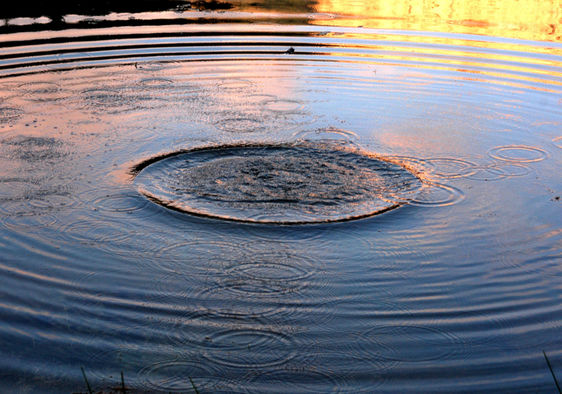
 How Being Kind to the Unkind Sends Ripples of Positivity Around ...

Tuesday, May 8, 2018

The Peace of Daily Things: Revising Wendell Berry for Ecofeminist Grief

I have often loved and taught Wendell Berry's poem, "The Peace of Wild Things," but struggle to really allow myself to take solace in it.

Given my recent dive into grief (see previous post, "The Vacuum"), I have continued to think about Berry's poem.

What bothers me about it is his use of nature as a crutch.  Someone I know and love often tells me that ultimately, the reason they can't dig religion is because of using God as a "crutch." But isn't Berry using nature as a crutch in this poem, in the same way? Manufacturing some idea of it, such that its sole purpose is to comfort a very human feeling of grief?  Honestly, I don't see the difference between God and Nature in so many claims.  Nature has taken over for God in a secular time, among my scientist and nature-loving friends and colleagues.

I'm not going to spend any more time right now on that issue, but would like to propose that Berry's poem doesn't work for someone like me, whose justice and feminist-oriented views of nature, much less grief, don't quite work the same way. I've been thinking about it a lot recently, and would like to offer this revision of Berry's poem, to suggest a feminist, perhaps overly domestic version that doesn't rely on an idea of nature as a thing "out there".

Rather, I hope this rings a Buddhist bell for you, regardless of the focus on motherhood, in terms of how grief has affected my sense of "the now" and my love of the things I've already spent so much effort cultivating.


____________________________

When despair for the world grows in me
And I wake in the night at the least sound
In fear of what my life and my children’s lives may be,
I go and lie down next to them
Rest in the beauty of their breathing, while the great heron feeds.
I come into the peace of daily things
That do not tax their lives with future and past
Or grief. I come into the presence of the texture of my daughter’s hair.
And I feel next to me the blinding purpose of warm skin
Content in our dark contact. For a time
I rest in the grace of Thou, and am not alone.

____________________________

If it helps to be reminded of Berry's poem:

____________________________

When despair for the world grows in me
 and I wake in the night at the least sound
 in fear of what my life and my children's lives may be,
 I go and lie down where the wood drake
 rests in his beauty on the water, and the great heron feeds.
 I come into the peace of wild things
 who do not tax their lives with forethought
 of grief. I come into the presence of still water.
 And I feel above me the day-blind stars
 waiting with their light. For a time
 I rest in the grace of the world, and am free.

_________________________

I wanted to challenge Berry's notion of nature as liberating us from the human. I wanted to challenge his notion of nature as a solace from the pain of daily life. I wanted to challenge his notion of the detachedness of nature from the human, and the notion of nature as peaceful, "still" like water, or feeding beautifully, as a heron would.  These projections of nature are inconsistent with my grief, and they are certainly inconsistent with the solace I find in my own ideas of nature.

In grief, I have found that I find solace in the mundane, in the comforts of daily life, in the gratitude of knowing there is so much love connecting me to things around me, especially my kids and immediate family. I don't need nature for that, but nature does help me focus on those things, sometimes. And nature is IN those things, always. 

This exercise of rewriting in the mode of another author reminds me of an exercise I'll never forget from seventh grade-- it was called "Imitation."  We would be given pieces of literature and asked to fill in the blanks to create similar structures but with our own images and ideas. Rewriting Berry allowed me to take HIM out of the poem, and leverage this sentiment and power of his poem for my own purposes.  

I can't write a poem about grief right now, but I can meditate on his.  

Monday, April 23, 2018

The Vacuum

I'm trying to get my head around the fact that on April 11, 2018, my gorgeous, capable, creative, and pregnant step-niece, mother of three young children, hanged herself.

My head is cracking open at the mental exercise of trying to grasp this information. My rudimentary understanding of mental health-as-illness, as opposed to a matter of will power or choice, is barely a consolation. My brain hurts, my heart hurts, my throat hurts, my womb hurts.

Her suicide feels like an asteroid has ripped a hole in the atmosphere, leaving everybody who knew her gaping open in agony. It's like what happens in airplanes when their windows rip out and everything inside gets torn to shreds in the nothingness that roars through. With great sorrow, I imagine her children and husband like passengers in the airplane, ripped out the windows of the sweet, beautiful life she painstakingly created for them. All of a sudden, even oxygen feels like a luxury. The hole left behind is heavy, irrefutable, dark, and empty.

Despite a challenging childhood, thin on many forms of crucial support, she built a dream life for herself, of which I was frequently envious. She mindfully manifested the world we could only dream of for her. She was extraordinarily crafty, making aesthetic DIY projects out of free items on Craigslist, creating a labyrinth of raised garden beds producing vegetables, flowers, and blueberries, and making fairy houses through the woods with her kids.  She adopted animals and friends into her life, generously giving of her energy to lots of living things that needed nurturance.

I know all mothers love their children, but she made mothering a mission. She planted so many seeds in the world, despite having been deprived of essential nutrients in her own childhood. Did she keep filling up the world with love and beauty in order to fill a hole inside herself? How could all that love and creativity be only directed outward, and not toward filling her own emptiness?

She and I weren't very close. But she was one of the most important people to somebody with whom I am very close-- my stepmother. Their relationship had its ups and downs, to be sure, but nobody held a firmer place in my stepmother's heart than this young woman. My stepmother did her best to be a loving, stable force for her, and to perhaps fill her own holes through that relationship. They had many reasons to hold tightly to each other.
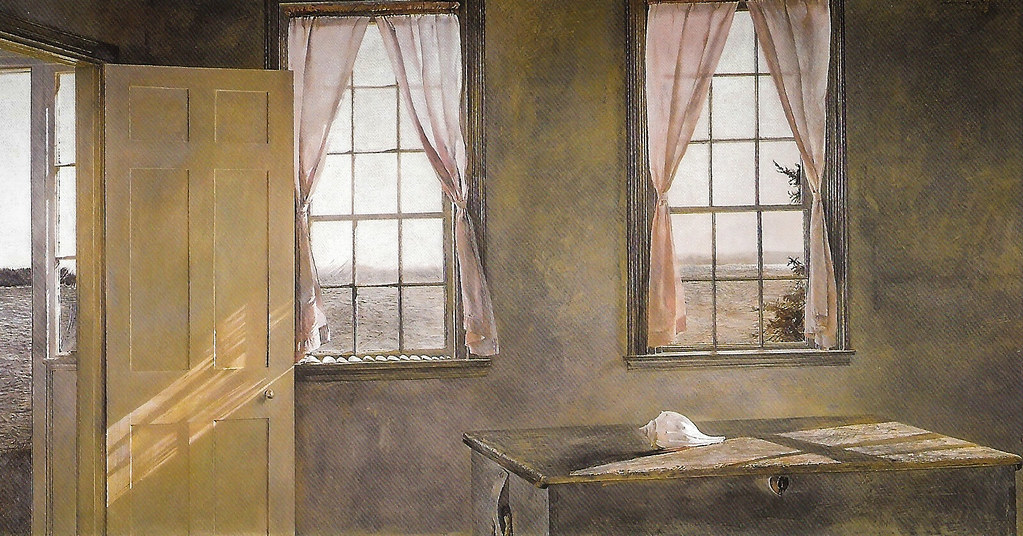
Image result for andrew wyeth maine art
I'm thinking a lot recently of Andrew Wyeth's hauntingly beautiful Maine images. As I look at "Her Room", I imagine my step-niece there. I gather she saw Maine as her escape from suffering. I imagine her in a room like this right now, at peace.
At the memorial service last week, at least 150 friends and family descended on my step-niece's idyllic northern California home. Her little children and her husband, having slept elsewhere for the previous week, came back to the garden she had spent the past several years building, came back to the critters and tiny-house dwellers on their property--friends from high school and from the ever-spiraling-out rhizome of a community my step-niece cultivated--and to the blueberries just ripening on the spring bushes.

In a poignant gesture of normalcy, the little girls squealed with delight at the sight of the first green, tiny blueberry of the season, which had come into being during their week of absence, during the week since their mother had been found. I can't decide if the marching on of nature is an insult or a comfort. How can they keep growing without her?

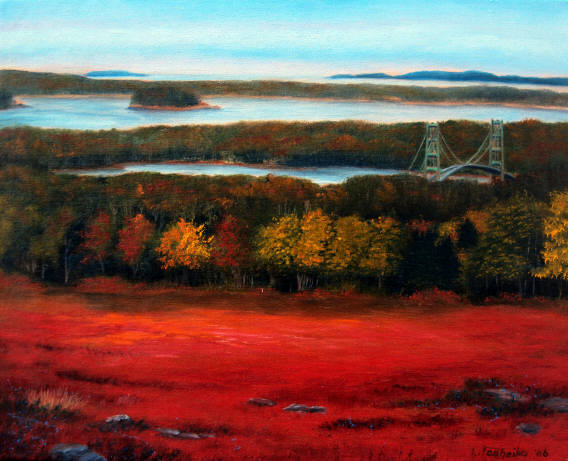
Image result for caterpillar hill blueberry field
Anybody who knows my step-niece knows that her love of blueberries started in Maine. These are blueberry fields in autumn, a view from Caterpillar Hill looking at the bridge to Little Deer Isle, where she spent a month each summer with my dad and stepmom. Despite her seemingly idyllic California life, she had bought a house in Stonington and was planning to move there soon.

Then I try to think of all the things she put into the world-- babies, blueberries, beauty-- and take some small comfort in knowing that although the vacuum is still tearing through the lives of those she left behind, so much of the love she created will come into being for years to come.