Most-Read

Saturday, July 8, 2017

Got Umwelt? A Children's Book that Will Blow Your Philosophical Mind


Animals have long been a major theme of children's books.  Animal studies critics historicize the beginning of this phenomenon, bemoaning the resulting infantilization of animals.  When children and animals become so closely associated, at least in the Western imagination, they are both demeaned, according to these critics, at least: animals become like children, and children like animals.

Having observed my own two children fall in love with reading, books, and their imaginations, not to mention animals, through children's books, it's hard for me to resist a great children's book about animals. But I'm particularly moved when I find a book that does justice to both animals and children.  They All Saw a Cat, by Brendan Wenzel, is one such book.



Got Umwelt?

The whole premise of this very simply written book is that all kinds of animals perceive the cat in all kinds of different ways.  The illustrations are evocative of a diversity of umwelts, or worldviews, to use Jakob von Uexküll's term.  Each page shows a different animal perceiving the cat, and each illustration evokes the unique possible ways that those different animals may perceive the cat.

So, for example, the worm might only perceive the cat through vibrations it feels underground as the cat walks above.  The illustration of this page shows only lines underground in the shape of a cat, surrounding the worm.

The bee sees a bunch of colored dots that make up a cat face.  The fox mostly hears a cat, right?  So it "sees"* in the illustration, at least, mostly a bell hanging around the cat's neck.  How about a bat?  It "sees" the cat as echolocation, of course. How would you represent that in a visual illustration?  In the book, it's a bunch of dots in the night that make the shape of a cat.  We "see" (or feel, or hear, or sense) the cat from the perspective of a snake (represented by the illustrator in infrared), a child, a bird, a bee, a flea, etc.
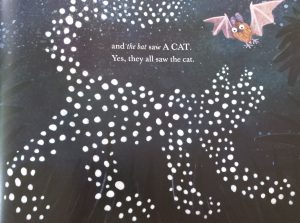

How would a bat "see" a cat? 


From the perspective of animal studies, this is precisely the kind of appreciation of animals we need more of in the world.  The reason for this is because animal studies critics don't like the fact that most Western representations of animals project human qualities or desires onto animals instead of seeing animals as potentially carrying their own perspectives, desires, and intelligences.  In most children's books, this means that animals play supportive, secondary roles to the child or human in the story.  They are blank slates on which to play out the drama of human needs.

They All Saw a Cat totally rejects that Western trope of the animal in children's books. It asks readers to imagine perceiving the world through all our senses, like so many animals do.  It demands that readers imagine what it would be like to go through the world as a bat, or a snake, or a bee, or even a worm.  In other words, it simultaneously asks readers to transcend our hubristic humanism that universalizes experience and knowledge of the world, and to put themselves in the place of each of these animals.  Through the worm, we learn what it might feel like to be anybody but ourselves.  This is the most important foundation of empathy.  Surely, if we're going to exploit animals in children's stories, this would be the right reason.


How would a fish "see" a cat? Watery and huge, looking at it through the fishbowl glass!


Of course, our protagonist is the cat, who walks through each page, encountering each of these animals.  After meeting a few animals, the cat gets its own page again, anchoring the reader in its perspective.  Every few pages, we read again, "And the cat walked through the world, with its whiskers, ears, and paws."

Why does Wenzel reiterate how the cat walked through the world, "with its whiskers, ears, and paws"? What is it about these things-- whiskers, ears, and paws, that require repetition in such a word-shy book?  What do whiskers, ears, and paws do for the cat?  Why are they so important?  Once again, they are the cat's main sensing organs-- notice that "eyes" are not part of that list.  Wenzel wants us to de-privilege sight/vision, which is humans' (or at least, Western humans') primary way of knowing the world. Think about how "we" (i.e. me and lots of people like me, but not necessarily you), come to know what is "true" in the world-- through SIGHT.  "You have to see it to believe it," right?

I can't help but think that Wenzel's totally down with von Uexküll, and really wants us to think about how other senses might tap into other truths, other worlds. This is a crucial insight of the philosophical theory of phenomenology--that the body (i.e. senses), not the mind (i.e. reason) gets us to the truth. So, the body and all its senses, no matter what kind of animal you are, determines your truth.  This is radical. It rejects the predominant theory of the father of Western philosophy, Rene Descartes, who told us that "cogito ergo sum" (I think, therefore I am). Many cite Cartesian dualism for separating humans from nature, and for authorizing the exploitation of all nature, including animals, as resources to be used for human needs.  In other words, if human reason derived through vision is the basis of all truth and knowledge, then animals (and anybody else) who perceives the world in any other way is less than human.

Wenzel is rocking my world with this children's book, which privileges all kinds of ways of perceiving multiple realities.  The book challenges any one objective, universal (e.g. "human") way of knowing truth, and privileges the truth that emerges from individual uniqueness-- what feminist philosophers call "standpoints".   How does Wenzel pack all this heady stuff into a children's book?
The book asks readers to get outside of themselves (and the realities we're imposing upon them) to grasp the ways in which other creatures and people feel and understand the world differently than they do.

The potential here for a nicer world, dare I say social justice, is huge. But what I love about the book is that Wenzel makes this argument without costing animals their own agency, or rendering their lives secondary to human plots and desires.

My daughter came up with the idea to paint how the bee sees the cat. See, this book ROCKS! 

*Why does Wenzel use the verb "sees" for all the animals, when his whole point is to get us out of ocularcentrism? I think it's to ask readers to rethink what "see" might mean for other creatures. Of course, you can't "see" vibrations or sounds, but that's the genius of the book: how to represent vibrations, sounds, heat, fear, and non-normative sight (e.g. "bird's eye view") in illustration?  Even though he uses "sees" when he really means "feels" or "hears", the accompanying illustrations expose the limits of the visual.  

Tuesday, June 27, 2017

4 Tips for Building Self-Care into Your Syllabus


Do you sometimes feel like the demands of your students overwhelm and deplete you?  Do you feel like you're the therapist for an increasingly emotionally-needy millennial student body?

Considering the myriad reasons that those students are righteous in their increasing emotional neediness (student loans, fear of deportation, climate crisis, just to name a few), students need more from us these days than they used to.  Add into the equation whether you are a female faculty, or even more so, a female faculty of color, and the "cultural taxation"-- expectations around your ability to be helpful to students navigating the emotionally-challenging terrain of college, based on your own identity-- of your energy, time, and love, may threaten your own self-care.

This post is an attempt to give you some tools that draw boundaries between you and your students' infinite, black hole of need for you.

1.  Cultivate Peer-Peer Support

The best support for your students is each other, not you.  Build peer-to-peer assignments into your syllabus.  Require that they check with each other before writing you.  I make my final exam an open-book, open-friend, open-everything assignment, so students are encouraged to talk to each other.  I do a lot of group assignments in class and outside of class. I try to create spaces for cross-generational mentorship: senior students are required to talk to my lower-division courses.  We hold world-cafe style chats about advising across these cohorts.  Get creative.  How can you design ways for them to help each other?

2.  Maximize Your Office Hours

This may be controversial, but I don't hold "by appointment" office hours any more.  Forget it! I'll never get anything else done if I pretend I'm available any time to meet.  Students need faculty support all times of the day, so this is a joke.  Also, one-on-one office hours need to be limited.  Students always come into my office, close my door, and unload for an hour.  I have 150 advisees; this just won't cut it.

So, I've decided I do one hour of immediate, live, email office hours per week, for easy, practical questions that may benefit from something like a conversation, but online.  I hold a group office hour every week during which community-building and conversation can occur.  I try to advertise them in terms of themes that I find myself discussing repeatedly with individual students.  Why not hold a "how to apply to grad school" office hour that you advertise, instead of talking to 20 individual students about this over the semester?  Are students worried about DACA?  Hold an office hour about it, where they can talk to each other, and perhaps you bring in a resourceful person on campus.  Is some trauma happening on campus?   Hold your next group office hour about it.  Ask students to make requests about topics, so you can serve more students in an hour than you ever could one-on-one.

I am grateful to the Latino Center for Academic Excellence at HSU for allowing me to hold these sometimes in their center.  As Fernando Paz, our director, states, "change the setting, change the outcome." Holding office hours in spaces outside your office is transformative for students.

Where could you hold office hours that would serve more students?

Finally, I hold one hour of 15-minute appointments that are designed ONLY for the students who simply must speak to you privately, and in person.  These are the default office hour appointments, but they just don't work when you have a huge demand.  One-on-one appointments need to be limited, or else I'll never survive.  I want to encourage students to ask themselves, "do I need to talk to Sarah privately about this, or is this something I could email her about, or perhaps meet with her in a potentially non-private setting?"  If they're asked to think that through, I think you'll find they don't need one-on-one with JUST YOU for every single question and anxiety that pops into their brilliant and lovely heads.

I find this creative office hour schedule strategy helps build community, makes students feel served, and saves me a lot of closed-door, hourly meetings with students who really need a therapist, and to whom I struggle to ask to leave my office.  I'm not trying to be mean or unavailable, but seriously, office hours have become a bottomless pit of time-suckage for me, and I'm desperate to figure out ways to serve students while serving myself.  This really has worked for me.

3.  Support Peer Mentoring

Recognizing how important peer-to-peer mentoring is for effective learning and retention, not to mention saving my own energy and time, I applied for a grant to launch a peer mentoring program.  Consider how you might do this at your institution.

4.  Account for Emotion in the Classroom

Save yourself the extracurricular emotional labor of supporting individual students by carving out space in class time to address heavy stuff.  This is no small ask.  When you know something big is happening with a few students, and you know it's going to involve more office hour meetings, why not put aside some content in favor of collectively working through the big emotional thing? I've learned the hard way too many times that this is a good idea.

What do you do?

Because let's face it, all this stuff is killing us too.  And we have to keep serving our students, keep surviving these traumas ourselves, keep fighting on all the fronts around us, keep feeding our babies, keep laughing and sleeping, keep taking leaps of faith "by virtue of the absurd", and sustaining ourselves to do all that work.

Saturday, June 24, 2017

Grappling with Despair in the Classroom: An ASLE Roundtable

At the Association for the Study of Literature and Environment conference this year, I organized a roundtable on climate justice pedagogies, and brought together some powerful instructors and one student to talk about how to deal with the depressing effects of studying environmental crisis and injustice.  Told to "save the planet, kill yourself," and observing our leaders undermine environmental and social justice, how do we expect the next generation to find a reason to live?


One of my students depicted his response to my class, ENST 295: Power, Privilege, and the Environment, with this fabulous Valentine's card: "This is your brain on ENST 295."


The roundtable extended a conversation prompted by SueEllen Campbell’s pre-conference ASLE workshop on teaching climate change at the 2015 conference in Moscow, ID, as well as LeMenager, Hall, and Siperstein’s new groundbreaking resource, Teaching Climate Change in the Environmental Humanities.  That superb volume doesn't outright engage affect theory, but every single piece speaks to the challenge of overcoming students' despair.  In my experience, students' affective response to the material I teach about structures of power and environmental injustice can become a barrier to learning.  I wanted to hear how my colleagues were addressing this challenge.


Covering experiences teaching in places from Georgia to Singapore, in a diversity of institutions from conservatory to land grant university to technical college, and to undergrads in majors ranging from music to engineering to composition, not to mention environmental studies, I gathered six participants who prepared talks responding to the following questions:
  1. How are you dealing with students' eco-grief, environmental despair, and even nihilism when they learn about climate change & environmental justice? 
  2. What is a justice-inflected pedagogy, and how might it add to climate change courses? 
  3. What is an affect-focused pedagogy, and how might it add to environmental or climate change courses?
  4. How does a climate justice pedagogy add to teaching climate change?
  5. What do you do with "hope" in your classes?
  6. How does the Trump era shape your pedagogy?
Other themes emerged, too, and I was glad to hear respondents talk about acknowledging that different students will respond to the material in different ways depending on their positionality.  In other words, students who have been experiencing environmental injustice in their lives are not shocked by the content.  I took note that I need to address this much better in my pedagogy.  

Jenn Ladino, an associate professor of English at the University of Idaho, opened the roundtable with some provocations and guiding questions. She asked, how can affect theory help explain emotions related to environmental change and loss, including new affects that are emerging in/with the Anthropocene? How is affect transmitted across scales, from individual to global and vice versa? What are the prospects for empathizing across species, and across temporal scales?  She argued that we need to attend to a wider range of affects in texts and classrooms, as well as some new ones that are emerging in the Anthropocene: climate grief, Anthropocene anxiety, solastalgia, even irreverence and humor, which I'm excited to learn more about in Nicole Seymour's book-in-progress, Bad Environmentalism.  

Jill Gatlin, faculty at the New England Conservatory of Music in Boston, argued that a justice-inflected pedagogy requires enabling students to understand their positionality and privilege vis-à-vis the unequal distribution of climate change consequences. However, emotional reactions to explorations of privilege may range from defensiveness to denial to guilt.  Jill described a course she taught that asked students to consider climate change's effects on a place that they are connected to, in order to make it more real to them.  As musicians, Jill's students also explored what "action" in response to climate change and injustice would mean. 

Robert Melchior Figueroa, an associate professor of philosophy at Oregon State University, argued that "academic cowardice" in this moment makes the assumption that students can't handle the truth.  He insisted that students can handle the emotional intensity of how terrible things are, and that a new vocabulary of affect is crucial for working through this with them: environmental guilt, environmental shame, environmental paralysis, environmental anger, environmental complacency, environmental complicity, and environmental honesty.  Importantly, Rob talked about the importance of exploring students' environmental identities and heritages for grappling with the doom-and-gloom with them.
 

Independent scholar Melissa Sexton provided a beautiful description of how she integrated this material "sideways" in composition courses with technical college students. She should run workshops on this. In contrast to Rob's provocation for us to get more honest, Melissa talked about the need to not alienate students.  She proposed that the concept of the Anthropocene is an easier one for students to engage without getting polarized into the tired old climate change sides.  She can get students to think critically about complicity, justice, technology, ethics, etc, with conversations about the Anthropocene, whereas climate change as a concept can shut down students' ability to think and learn.

Matthew Scheider-Mayerson, assistant professor at Yale-NUS Singapore, talked about the challenge of teaching climate change in that country.  In Singapore, a wealthy illiberal democracy with no recent tradition of social movements, he finds that the pedagogical path that had succeeded in the United States – guiding students from complacency to awareness to outrage and a desire for engaged citizenship and political action – was far less successful.  He argued that instructors model affective responses, intentionally or not, and vulnerability, grief, and honesty become important in the classroom. The typical posture of cautious optimism is not the ideal orientation, he argued.  Like others on this roundtable, he suggested that we sit with the grief with our students, even as we find ways for them to channel their desire to solve problems, act, etc.
 
Finally, a recent graduate of the Environmental Studies program I lead at Humboldt State, Carlrey Arroyo Delcastillo, spoke from her experience as a student of color in a predominately white institution.  It was this talk that really prompted me to think about the ways in which the affective journeys of the white students in my classes dominate my own design of the class.  Attending to white fragility, shock at their privileged complicity, apathy about whether they can/should really save the world as they had hoped, and tears over all the evil in the world, can be silencing to students who have different affective responses to the material.  Carlrey talked about her journey toward a social justice approach to environmental activism, and ended with something like, "it's ironic that I went into environmental studies because I hated humanity, and now my work is based on my love for it."  I'm pretty sure there wasn't a dry eye in the audience.  And what a way to end-- on love.

The room was packed. People were lined up against the walls.  It indicated to me that instructors of environmental and climate justice are desperate for pedagogical tools to help students grapple with this material.  My colleagues and I are worried about our students-- the next generation of people who are inheriting this mess.  

How do you deal with emotion in your classrooms?